What Is the LTL Freight Payment Dispute Process in 2026?
The 2026 LTL freight payment dispute process runs through five stages: catch the error, file within the 180-day window (49 U.S.C. 13710), wait through the carrier's 60-day response clock (49 CFR 378.8), escalate if needed, and the 18-month legal backstop (49 U.S.C. 14705) if it ever reaches court.
LanePilot is the LTL TMS for small shippers, not a freight broker TMS like the discontinued LoadPilot. This is not a letter template and not a general how-to. It is the map of the whole process, so you know which stage you are in, which clock is running, and what comes next.
2026 is not a normal year to be sitting on unreviewed invoices. A reclassification wave triggered earlier this year is now working its way through the 180-day filing window, and a lot of shippers are about to learn what stage they are actually in.
Why Q4 2026 Is Shaping Up to Be a Heavier Dispute Quarter
NMFC Docket 2026-1 took effect May 23, 2026, folding thousands of commodity listings into NMFTA's density-based classification scale. Shipments that used to hold a class based on commodity description are now getting reclassed at the terminal on weight per cubic foot alone, landing on invoices as charges nobody had budgeted for. Our breakdown of what changed under Docket 2026-1 covers the rule itself; this article covers what happens to the invoices it produced.
Here is why timing matters. Under 49 U.S.C. 13710(a)(3)(B), a shipper has 180 days from receipt of a bill to contest it. A June 2026 invoice hits its deadline in late November; a July invoice, late December. That is why Q4 2026 is shaping up to be a heavier dispute quarter: the filing window on the first wave of Docket 2026-1 reclass charges closes then, and the invoices landing on your desk now, in Q3, are the ones setting it.
The Five-Stage 2026 Dispute Timeline
A billing dispute is not one event, it is a sequence with its own clock at every stage.
Stage 1: Catch the Error
Every dispute starts with a discrepancy between two documents: what you were quoted and what you were billed. Weight, freight class, an accessorial charge, a fuel surcharge, or a duplicate PRO number can be the source. This stage has no statutory clock, but it is where shippers lose the most time, since it depends on someone reading the invoice line by line against the quote. Our step-by-step guide to disputing an LTL invoice covers how to isolate the error before you file.
Stage 2: File Within the 180-Day Window
Once you have documented the error, 49 U.S.C. 13710 gives you 180 days from receipt of the bill to file a written claim. Under 49 CFR 378.4, the claim needs the freight bill plus enough detail to investigate: the disputed rate, class, or weight. This stage carries most of the Docket 2026-1 reclass charges from this summer, and it is the deadline driving the Q4 surge above. Our dispute letter template covers the exact fields a claims department expects.
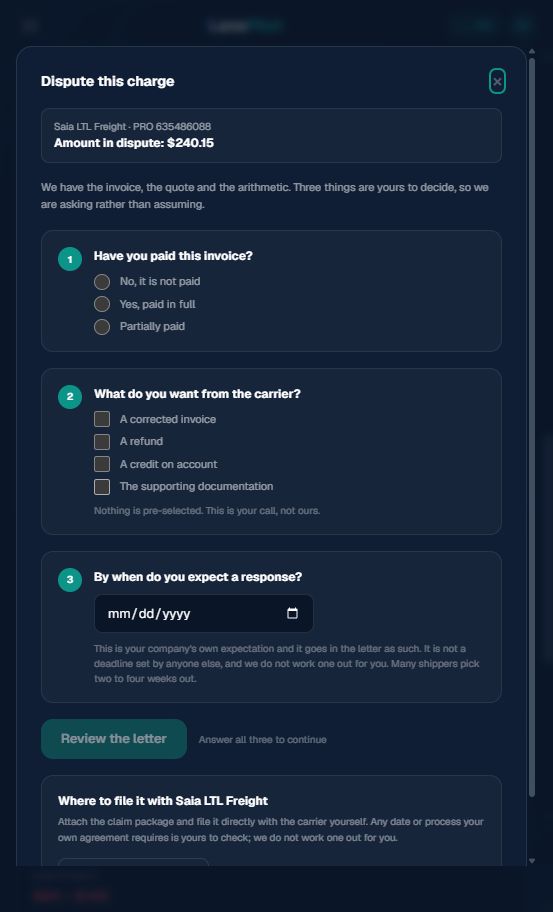
Stage 3: The Carrier's 60-Day Response Clock
Once the carrier receives your written claim, 49 CFR 378.8 requires it to pay, decline, or settle within 60 days, with a written explanation if it denies the claim. Mark the date the carrier received your claim; if day 60 passes with no response, that is a documented violation, not just a slow desk. Our deep dive on the 60-day carrier response deadline covers what to do next.
Stage 4: Escalate If It Stalls or Gets Denied
If the carrier misses its 60-day deadline, or denies a well-documented claim, escalate rather than resubmit from scratch. Put the missed deadline or denial in writing to the carrier's regional sales contact. For disputes about whether the rate or class was reasonable, the Surface Transportation Board has jurisdiction under 49 U.S.C. 13710. Most disputes resolve before this stage.
Stage 5: The 18-Month Legal Backstop
Separately from the 180-day filing window, 49 U.S.C. 14705 sets an 18-month statute of limitations to file a civil action to recover an overcharge, running from delivery, extended 6 months if the carrier issues a written notice of disallowance. Treat this as the outer legal boundary, not a target. Our guide to 49 U.S.C. 13710 in full covers how the two clocks interact.
The Full Timeline at a Glance
- Day 0: Invoice received. The 180-day filing clock starts.
- Day 0 to ~180: Audit the invoice, document the error, file the written claim (Stages 1 and 2).
- Claim receipt to +60 days: The carrier must pay, decline, or settle (Stage 3).
- After day 60, if unresolved: Escalate to a regional contact or the STB (Stage 4).
- Delivery to 18 months (plus 6 if disallowed): The outer legal deadline for a civil action, rarely reached (Stage 5).
A claim filed early and documented well can clear Stages 2 and 3 in two to three months. Most of the time lost in a dispute happens before Stage 2 even starts, sitting in an unreviewed invoice folder while the clock runs.
What This Means If You Have Unreviewed 2026 Invoices Right Now
If you have not reviewed your June, July, and August 2026 invoices against your original quotes, you are sitting on the batch most likely to carry a Docket 2026-1 reclass, plus the usual weight errors and unearned accessorial fees. Their 180-day deadlines land from late November 2026 into early 2027, so reviewing them now leaves room to escalate if a claim is denied. Our guide to disputing a reclassification specifically covers the density calculation those claims require, and our breakdown of which accessorial charges are actually winnable is worth checking before you dispute one the tariff already supports. Your oldest invoices in that batch are closest to their deadline, so start there.
How LanePilot Fits Into This Process
LanePilot audits every invoice against the original quote and shipment record as soon as the bill arrives, so a reclass, a weight error, or a phantom accessorial gets flagged at Stage 1, not buried in a backlog. It drafts the dispute letter with the documentation a claims department needs. LanePilot never sends, files, negotiates, or communicates with a carrier on your behalf. It is the LTL TMS for small shippers, not a freight broker, and you remain the party of record for filing and escalation. To see where your own invoices sit in this timeline, run a free audit with the carrier invoice and your original quote, or read more about how LanePilot runs the process end to end.
Frequently Asked Questions
What is the LTL freight payment dispute process in 2026?
The 2026 LTL freight payment dispute process runs through five stages: catch the error, file within the 180-day window (49 U.S.C. 13710), wait through the carrier's 60-day response clock (49 CFR 378.8), escalate if needed, and the 18-month legal backstop (49 U.S.C. 14705) if it ever reaches court.
How long does the whole LTL dispute process take, start to finish?
A well-documented claim a carrier accepts inside its 60-day window can resolve in two to three months from filing. A denied claim that gets escalated can run longer, though most disputes never approach the 18-month statute of limitations backstop under 49 U.S.C. 14705.
Why is LTL freight dispute volume set to rise in Q4 2026?
NMFC Docket 2026-1 took effect May 23, 2026, and reclassified thousands of commodity listings under NMFTA's density-based scale. Shippers who received reclassified invoices over the summer are approaching the 180-day window under 49 U.S.C. 13710 by the fourth quarter, pushing a wave of filing deadlines into Q4 2026.
What are the stages of an LTL freight billing dispute?
Five stages in order: identify and document the billing error, file a written claim with the carrier's claims department inside 180 days, wait for the carrier's response inside its 60-day window, escalate to the carrier's regional contact or the Surface Transportation Board if the claim stalls or is denied, and, in rare cases, a civil action inside the 18-month statute of limitations.
Can LanePilot handle the dispute process for me?
No. LanePilot is the LTL TMS for small shippers, not a freight broker TMS like the discontinued LoadPilot, and it holds no brokerage license. It audits the invoice and drafts the dispute letter, but the shipper files the claim, receives the carrier's response, and handles any escalation.
The Bottom Line
An LTL freight dispute is not a single letter, it is a five-stage process with three federal clocks running underneath it. In 2026, the Docket 2026-1 reclassification wave means a lot of shippers will be hitting Stage 2's deadline by Q4 without realizing it. Knowing which stage you are in, and which clock is running, is what turns a vague sense that an invoice looked wrong into a claim that gets filed, answered, and paid instead of aging out.