Reference
LTL accessorial charges: what triggers each one
Most freight glossaries define a liftgate fee as "a charge for using a liftgate." That is not useful. What a shipper actually needs is the trigger condition: what causes the charge to fire, who decides, what it is calculated on, and what evidence disputes it. Every entry below traces to a published carrier rules tariff or to NMFTA, not to general knowledge. Carriers genuinely differ on thresholds and qualifying locations, so where they diverge, this page says so instead of picking one carrier's number and presenting it as universal.
By Aaron Brown, Founder & CEO · Reviewed by Aaron Brown · Published · Updated
Three holds, three clocks: detention, "demurrage," and storage
These three get confused constantly, and blurring them is the fastest way to look wrong to anyone who actually runs freight.
1. Detention
The driver and the truck, waiting at the shipper's or consignee's dock past free time. Billed in short increments, often every 15 minutes.
2. "Detention without power"
A trailer, without its tractor, left at that same dock past free time. Most LTL tariffs bill this under the detention item rather than a separately named "demurrage" line, but it is functionally what intermodal and drayage carriers call demurrage: equipment, not a driver, held at a facility, billed per day.
3. Storage
Freight sitting in the carrier's own possession, usually at its terminal, because nobody has picked it up or accepted delivery. A different location and a different clock from either detention charge.
Access and equipment at the stop
These fire based on the physical site: what kind of location it is, what equipment it has, and where the freight actually has to end up.
Liftgate
also: Liftgate service, Liftgate charge- Trigger
- Fires when the pickup or delivery point has no loading dock and no forklift, so the driver has to raise or lower the freight with the truck's own hydraulic gate. Whether it is needed is a judgment call made at the stop (or requested in advance by the shipper), not something the freight itself declares.
- Priced on
- Most carriers price it per 100 lbs of shipment weight with a flat minimum and maximum, and cap what a single piece or pallet can weigh. R+L Carriers states a 2,000 lb per-pallet limit and a 48 in x 60 in maximum pallet size on its own liftgate page (Rules Tariff Item 520); Pitt Ohio bands the flat charge by shipment weight up to an 18,000 lb ceiling (Item 571). Thresholds are carrier-specific.
- Confused with
- Inside delivery, which is billed separately once the freight is past the truck and the threshold, not for lowering it to the ground.
- What disputes it
- A delivery receipt or driver note stating no liftgate was used, or a signed bill of lading that never requested the service. Once freight is unloaded there is usually no independent record either way, which is why this one is far easier to prevent at booking than to fight afterward.
Source: R+L Carriers Liftgate Service page (Rules Tariff Item 520); Pitt Ohio Rules Tariff Item 571
Residential delivery
also: Residential pickup/delivery, Non-commercial delivery- Trigger
- Fires when the pickup or delivery address is classified residential rather than a commercial dock, which is broader than "a house": Pitt Ohio's tariff explicitly folds in businesses operated out of private residences under this same charge (Item 753). The carrier classifies off the address, not off the shipper's description of the business.
- Priced on
- Priced per 100 lbs with a flat minimum and maximum (Pitt Ohio: $8.75/cwt, $90 minimum, $250 maximum, Item 753; Estes: $8.50/cwt, $75 minimum, $550 maximum, Item 751). XPO folds residential and limited access into one combined item (Item 224) rather than pricing them separately, which is not how every carrier does it.
- Confused with
- Limited access, a separate and broader category covering non-residential sites the general public cannot freely enter.
- What disputes it
- The shipping address itself, if it is demonstrably a commercial dock (a business license, a photo of the loading dock, or the carrier's own address classification), is what overturns a residential charge billed by mistake.
Source: Pitt Ohio Rules Tariff Item 753; Estes Accessorial Charges (Item 751); XPO CNWY 199 (Item 224)
Limited access
also: Limited access delivery, Limited access pickup/delivery- Trigger
- Fires when the pickup or delivery point is a site type the carrier's own tariff names as restricted, and that list is long, specific, and carrier-by-carrier. Pitt Ohio's tariff names schools, universities, country clubs, farms, military bases, nuclear plants, prisons, self-storage facilities, churches, funeral homes, day cares, nursing homes, and airports (with its own TSA-based definition), closed by a catch-all for "any other sites requiring inspection of driver or vehicle before permitting access" (Item 756), a deliberately open-ended net.
- Priced on
- Priced per 100 lbs with a minimum and maximum on most tariffs (Pitt Ohio: $9.00/cwt, $100 minimum, $250 maximum, Item 756), or as a flat per-shipment charge on others (Estes: flat $85, Item 751-10).
- Confused with
- Residential delivery (a separate named category on most tariffs, though XPO bills both under one item) and construction site delivery, which some carriers fold into this same charge and others price separately.
- What disputes it
- The specific site's characteristics measured against the carrier's own published definition, since the tariff language is deliberately broad. This is the hardest of the group to win after delivery; the stronger move is checking the named carrier's limited-access list before booking to a site that might qualify.
Source: Pitt Ohio Rules Tariff Item 756; Estes Accessorial Charges (Item 751-10); XPO CNWY 199 (Item 224)
Inside delivery
also: Inside pickup/delivery, Positions not immediately adjacent to vehicle- Trigger
- Fires when freight has to move past the point immediately adjacent to the truck: through a doorway, past a threshold, or to a floor reached only by elevator. Pitt Ohio's tariff ties it explicitly to distance beyond the standard loading or unloading position (Item 566), and requires that any elevator or escalator service used be available at no cost to the carrier.
- Priced on
- Priced per 100 lbs with a minimum and maximum, applied per stop separately when a shipment is split across multiple stops (Pitt Ohio: $8.75/cwt, $90 minimum, $775 maximum, Item 566).
- Confused with
- Liftgate, which only covers lowering freight to ground level. Inside delivery is the separate charge for what happens after it is on the ground.
- What disputes it
- A delivery receipt or floor plan showing the freight was left at the immediately adjacent, standard position (not moved further inside) is what contradicts an inside-delivery charge.
Construction site delivery
also: Construction or wrecking site delivery- Trigger
- Whether this is even its own charge differs by carrier, which is exactly why it is listed separately here. Pitt Ohio's tariff has no independent construction-site item; Item 755 simply points to the limited-access charge (Item 756), which itself lists "construction or wrecking sites" inside its catch-all. XPO instead prices "Construction and Utility Sites, Pickup or Delivery" as its own line (Item 201), separate from its Residential/Limited Access item.
- Priced on
- Where it is a standalone item, it is typically a flat per-shipment charge (XPO: $170.50, Item 201). Where it is folded into limited access, it takes that charge's per-cwt structure and minimum/maximum instead.
- Confused with
- Limited access generally. Whether a construction site is billed under that broader charge or its own line depends entirely on which carrier is moving the freight.
- What disputes it
- The site type itself, and which item the specific carrier's tariff files it under, since the same site can be billed two different ways depending on the carrier.
Source: Pitt Ohio Rules Tariff Item 755 (referring to Item 756); XPO CNWY 199 (Item 201)
Time
These fire based on a clock. Which clock, and where it is running, is the single most confused distinction on this page. See the callout above.
Detention (with power)
also: Driver detention, Detention with power units- Trigger
- Fires when the carrier's tractor and trailer are held at the shipper's or consignee's premises, through no fault of the carrier, beyond the free time allowed for loading or unloading. Pitt Ohio ties free time to shipment weight (30 minutes up to 5,000 lbs, 45 minutes up to 7,500 lbs, 60 minutes above that) and states the clock starts when the driver arrives on the premises and ends when loading or unloading is complete and the driver has a signed bill of lading or delivery receipt in hand (Item 190).
- Priced on
- Billed in short increments after free time expires, commonly every 15 minutes (Pitt Ohio: $45 per 15 minutes; Estes: $40 per 15 minutes under 20,000 lbs, Item 500).
- Confused with
- Detention without power and storage, the other two clocks below. This is the only one of the three where the driver and the truck are actually waiting at the stop.
- What disputes it
- The arrival and departure timestamps on the signed delivery receipt or dock log are the specific record that supports or contradicts a detention charge. A dock log showing a shorter wait than billed is a provable dispute.
Source: Pitt Ohio Rules Tariff Item 190; Estes Accessorial Charges (Item 500); XPO CNWY 199 (Item 211)
Detention (without power)
also: Trailer detention, Demurrage (functionally)- Trigger
- This is the second, easily confused clock. It fires when a TRAILER, not the tractor and driver, is left at the shipper's or consignee's premises past free time, typically because loading or unloading could not finish in a normal business day and the customer asked the carrier to leave the trailer rather than send it back empty. Pitt Ohio's tariff spells this out directly under "Detention, Vehicles Without Power Units": the carrier spots the trailer, the customer does the loading or unloading, and free time (24 hours, excluding non-business days) starts from when the trailer is spotted (Item 190).
- Priced on
- Priced per trailer per 24-hour period, not in short increments (Pitt Ohio: $100/trailer/24 hours, $175 with heated equipment; Estes: $110 first 24 hours, $150 next 24 hours, $225 per day after, Item 501; XPO: $206/day, Item 212; Dayton Freight: flat $150.00 per day after 12 free hours, Item 500).
- Confused with
- Detention with power (the driver and truck actively waiting, billed in minutes) and storage (freight at the CARRIER's own terminal, not at a customer's dock). LTL carriers rarely use the word "demurrage" on a freight bill; this hold is almost always billed as "detention without power," but it is functionally what intermodal and drayage carriers call demurrage: equipment held at a facility, on its own daily clock, not a driver. Dayton's own tariff makes the naming variance explicit: it calls this "spotting" or "dropping" a trailer, uses those two words interchangeably, and bills it under the SAME item number as its powered-detention charge (Item 500) rather than a separate one.
- What disputes it
- The trailer spot and pickup timestamps in the carrier's own dispatch or activity log, checked against the free-time window.
Storage
- Trigger
- This is the third clock, and it is not the same location as either detention charge above: storage is freight sitting in the CARRIER's own possession, usually at its destination terminal, because the consignor, consignee or owner has not disposed of it, not because a driver or trailer is waiting anywhere. Pitt Ohio's tariff sets several separate storage triggers with separate start times: freight awaiting linehaul movement, undelivered freight (starting a set number of hours after notice of arrival or a disposition request), and freight refused after a scheduled delivery notification (Item 910).
- Priced on
- Priced per 100 lbs per 24-hour period with a minimum and maximum (Pitt Ohio: $2.00/cwt/24 hours, Item 910; a higher rate applies if the stored freight also needs protection from freezing). XPO grants two full business days free before storage starts accruing (Item 231).
- Confused with
- Both detention charges. The test: is this a truck or trailer waiting at a customer's dock (detention), or is it freight sitting at the carrier's own terminal because nobody has come to get it or accept it (storage)? Different location, different clock, different item number on every tariff checked for this page.
- What disputes it
- The carrier's own arrival notice and the date disposition instructions were actually given (or the date a delivery was refused) are the specific records that set when the storage clock legitimately started.
Source: Pitt Ohio Rules Tariff Item 910; Estes Accessorial Charges (Item 910); XPO CNWY 199 (Item 231)
Redelivery
- Trigger
- Fires when a first delivery attempt fails through no fault of the carrier and a second attempt is made. Pitt Ohio's tariff states that after a failed first attempt during business hours, no further attempt is made except on the consignee's request (Item 830), so the charge is really billing the second trip, not the failure itself.
- Priced on
- Priced per 100 lbs with a minimum and maximum, subject to a fuel surcharge and generally capped at the original freight charge (Pitt Ohio: $14.00/cwt, $105 minimum, $700 maximum, Item 830). The charge applies again for each additional attempt.
- Confused with
- Storage. Pitt Ohio's own tariff states that if a shipment still cannot be delivered after the first redelivery attempt, it becomes subject to storage instead (Item 830), so a failed second attempt can hand off to a completely different charge.
- What disputes it
- The delivery receipt or dock log for the first attempt: did it show a genuine attempt during business hours, or a reason outside the shipper's control (wrong address on file, nobody available), versus a reason the carrier can fairly bill for.
Source: Pitt Ohio Rules Tariff Item 830; Estes Accessorial Charges (Item 830); XPO CNWY 199 (Item 229)
Appointment or notification
also: Notification prior to delivery, Scheduled delivery- Trigger
- Fires when the bill of lading carries a notation asking the carrier to call ahead or schedule a delivery window, or when the consignee's own operating practice requires it regardless of what the bill of lading says. Pitt Ohio treats both cases the same way: the requirement to coordinate before the truck arrives is the trigger, not any particular difficulty at the stop itself (Item 647).
- Priced on
- Flat per-shipment charge (Pitt Ohio: $39.00, Item 647; Estes: $30.00, Item 647; XPO: $64.25, Item 253).
- Confused with
- Detention. Requesting an appointment is a separate, flat, upfront charge; showing up for the appointment and then being made to wait past free time is detention, billed on top.
- What disputes it
- The bill of lading itself, whether it actually carries the notification request, is the specific record. A charge with no corresponding notation and no standing customer requirement on file is worth challenging.
Source: Pitt Ohio Rules Tariff Item 647; Estes Accessorial Charges (Item 647); XPO CNWY 199 (Item 253)
Handling
These fire based on extra physical work at the dock: labor, separation, or a shipment's shape and density.
Sort and segregate
- Trigger
- Fires when the shipper, consignee or payor asks the carrier to separate freight by SKU, PO, store or destination on delivery, rather than delivering it as one undifferentiated shipment. Several tariffs, including Pitt Ohio's, bill this under the SAME line item as marking and tagging (Item 581, "Sorting, Segregating, or Marking of Freight"), which is worth knowing because other carriers price the two separately.
- Priced on
- Priced per 100 lbs with a flat minimum (Pitt Ohio: $3.70/cwt, $95 minimum, Item 581; Estes bills it separately at $1.00/package or $2.70/cwt whichever is greater, $90 minimum, Item 886).
- Confused with
- Marking and tagging, which some tariffs bill as the identical item and others bill separately. Check which convention the specific carrier on the invoice uses.
- What disputes it
- Whoever requested the sort or segregation, and in writing, is the record that matters: this is a requested service, so a charge with no request behind it (verbal or on the bill of lading) is the one to challenge.
Source: Pitt Ohio Rules Tariff Item 581; Estes Accessorial Charges (Item 886)
Driver assist / lumper
also: Extra labor, Lumper service- Trigger
- Fires when the driver, or a third-party lumper crew the carrier arranges, does loading or unloading labor beyond simply driving the truck, because the shipper or consignee has no dock crew or equipment of their own. XPO bills this as two distinct items: "Extra Labor, Load or Unload" for the carrier's own driver doing the work (Item 214), and a separate "Lumper Service Fee" that passes through a third-party lumper's actual charge plus a processing fee (Item 242).
- Priced on
- Priced hourly per laborer with a minimum (Estes: $300 for the first 3 hours or less, then hourly, Item 560; XPO: $451 minimum plus $161/labor hour, Item 214). Lumper reimbursement passes through the lumper's own invoice plus a flat processing fee (XPO: $11.05, Item 242).
- Confused with
- Sort and segregate and inside delivery, both also labor-based, but each bills for a specific service rather than general loading or unloading assistance.
- What disputes it
- A time log (for extra labor) or the lumper's own receipt (for a lumper reimbursement), compared against what was billed.
Source: XPO CNWY 199 (Item 214, Item 242); Estes Accessorial Charges (Item 560)
Single shipment
- Trigger
- Fires on a small shipment picked up alone, with nothing else from the same shipper at the same pickup site at the same time. Pitt Ohio's tariff states the exact trigger: "500 pounds or less picked up at one time and place unaccompanied by any other shipment from the same pickup site" (Item 1032).
- Priced on
- Flat per-shipment charge, explicitly not eligible for discounts (Pitt Ohio: $50.00, Item 1032; XPO: $57.75, Item 230).
- Confused with
- Capacity load or cubic capacity, which are about a shipment's low density relative to trailer space, not about whether other freight was picked up alongside it.
- What disputes it
- The pickup manifest for that stop, showing whether another shipment from the same shipper actually moved on the same pickup.
Source: Pitt Ohio Rules Tariff Item 1032; XPO CNWY 199 (Item 230)
Overlength / excessive length
- Trigger
- Fires when a single piece, not the trailer space it occupies, meets or exceeds a length threshold, and the thresholds are banded rather than a single cutoff. Pitt Ohio's tariff also adds a separate fee specifically when overlength freight was NOT declared as such on the bill of lading (Item 670), so an undeclared long piece can draw two charges.
- Priced on
- Banded flat per-shipment charges rising with length (Pitt Ohio: $115 at 7 ft rising to $2,200 at 40 ft and up, Item 670; Estes and XPO both band starting at 8 ft, at different dollar amounts).
- Confused with
- Capacity load / cubic capacity, a density-based charge, not a length-based one. A shipment can trigger one, the other, or both.
- What disputes it
- The actual measured length of the longest piece, against the declared length on the bill of lading. If your own measurement at booking matches or beats the declared length, an extra undeclared-length fee has no basis.
Source: Pitt Ohio Rules Tariff Item 670; Estes Accessorial Charges (Item 670-10); XPO CNWY 199 (Item 238)
Capacity load / cubic capacity
- Trigger
- Fires when a shipment is so light for its size (low density) that it takes up a disproportionate share of trailer space relative to its billed weight. XPO's tariff states the exact mechanical trigger: a shipment needing 350 to 750 cubic feet of trailer space at an average density under 3 pounds per cubic foot, or 750 cubic feet or more at a density under 6 pounds per cubic foot (Item 233).
- Priced on
- Not a flat fee: the shipment is re-rated. XPO's formula multiplies the shipment's cubic feet by 6 to produce a resultant weight, then rates that resultant weight at class 125 (Item 233), regardless of the commodity's normal NMFC class.
- Confused with
- Reclassification, which is the carrier changing the declared class based on density measured at the terminal. Capacity load is a separate re-rating rule specific to very-low-density shipments taking up trailer cube.
- What disputes it
- Your own measured cubic footage and weight at booking, checked against the specific density thresholds in that carrier's tariff.
Source: XPO CNWY 199 (Item 233)
Protect from freezing
- Trigger
- Fires only on freight that would be damaged by freezing, and only when specifically requested and documented in advance; it is seasonal and geography-gated, not automatic. Pitt Ohio requires the request endorsed on the bill of lading, the freight physically labeled "Protect from Freezing," and runs its U.S. season October 1 through April 30 (year-round for Canada), restricted to a named list of states (Item 810). Miss the labeling or the notation and the carrier has no liability for freeze damage, regardless of whether the charge was paid.
- Priced on
- Priced per 100 lbs per 24 hours the freight is in the carrier's possession, with a minimum (Pitt Ohio: $2.75/cwt, $40 minimum, Item 810).
- Confused with
- Storage. If freight requiring freeze protection is also sitting at the terminal, both charges can apply, and Pitt Ohio bills the freeze-protected version of storage at a distinctly higher rate than ordinary storage (Item 910).
- What disputes it
- The bill of lading notation and the physical label are the two specific things that determine whether the request was ever actually made.
Source: Pitt Ohio Rules Tariff Item 810; Estes Accessorial Charges (Item 809)
Documentation and correction
These fire when the carrier corrects, redirects, or re-documents a shipment after the fact.
Reweigh
- Trigger
- Fires when the carrier puts the shipment on a certified terminal scale and the actual weight comes back different from what was declared on the bill of lading, and the carrier corrects the billed weight to match. Pitt Ohio ties the charge to the SIZE of the resulting adjustment: a weights-and-inspection charge applies whenever an inspection or reweigh changes the linehaul charges, at a higher flat fee if the adjustment is $10 or more (Item 996).
- Priced on
- Flat per-bill charge, separate from and in addition to the corrected linehaul charges themselves (Pitt Ohio: $25 for a $10-or-more adjustment, $10 for a smaller one, Item 996; XPO: flat $45.50, Item 239; Dayton Freight: flat $32.00 regardless of adjustment size, Item 1015, and also charged if a shipper, consignee or third party simply requests weight verification with no dispute involved).
- Confused with
- Reclassification. The same weight-and-inspection item on Pitt Ohio's tariff actually covers both a weight correction and an NMFC class correction, so one invoice line can represent two different corrections. Dayton's tariff makes the same combination even more explicit: Item 1010 covers weight, class and even released-value corrections together, distinct from its separate weighing-service item (1015).
- What disputes it
- A weight and inspection (W&I) certificate or scale ticket tied to the specific PRO number, showing a certified weight, date and terminal, is the documentation a legitimate reweigh should carry. Your own shipping-scale ticket from the time of pickup is the strongest evidence if the carrier's certificate does not exist or does not match.
Reclassification
- Trigger
- Fires when the carrier remeasures and reweighs a shipment at the terminal, calculates a different density than what was declared, and assigns the NMFC class that density maps to under the current density-based classification scale. NMFTA, through its Freight Classification Development Council, expanded that density scale from 11 bands to 13 under Docket 2025-1 (effective July 19, 2025), and density is now the primary classification factor for most general commodities with no unusual handling, stowability or liability characteristics.
- Priced on
- The billed rate changes to whatever the newly calculated NMFC class carries. On carriers whose tariff combines this with reweigh under one item (see above), the flat correction fee is the same as a plain reweigh. Dayton Freight sets an explicit dollar floor on the same combined item: a $32.00 correction fee applies only once the resulting change to the linehaul charge is $1.00 or more, Item 1010, so a reclass that nets out to less than a dollar of difference carries no fee at all.
- Confused with
- Reweigh: a reweigh corrects weight, a reclassification corrects the class the freight is rated under. The two often happen at the same terminal inspection, and sometimes on the same tariff item, but they are two separate corrections.
- What disputes it
- Recalculating the density yourself (actual weight divided by cubic volume, the same method NMFTA's own classification standard uses) and comparing it to the billed class. LanePilot's free freight class calculator runs this exact calculation from a shipment's dimensions and weight. If your number supports the original class and the carrier has no inspection report or dimension record behind the reclass, that is a quantified dispute.
Reconsignment / diversion
- Trigger
- Fires when the consignor, consignee or owner asks to change the shipment's destination, consignee name, or delivery point after it has already been tendered. Pitt Ohio's tariff draws a sharp line on cost by WHEN the request happens: a change made before the shipment departs origin is a flat fee, but a change requested after the shipment has already departed, or after tender of delivery, is billed at a full new linehaul rate from wherever the shipment currently is to the new destination (Item 820), not just a service fee.
- Priced on
- Flat fee for an early change (Pitt Ohio: $33.75, Item 820); the full tariff rate from the reconsignment point to the new destination, never less than the original origin-to-destination rate, for a change requested after the shipment is already moving.
- Confused with
- Blind shipment, a request made in advance to hide the shipper's or consignee's identity. Reconsignment is a request made mid-move to change WHERE the freight actually goes.
- What disputes it
- The written reconsignment request (Pitt Ohio's tariff requires it in writing, or confirmed in writing if made by phone) and its timestamp against when the shipment actually departed. A reconsignment fee with no written request behind it has no basis.
Source: Pitt Ohio Rules Tariff Item 820
Blind shipment
- Trigger
- Fires only when specifically requested BEFORE pickup, to keep the shipper's and consignee's identities hidden from each other because a third party (a broker or distributor) is controlling the move. Pitt Ohio's tariff spells out the mechanics: a request made after pickup is handled as a reconsignment instead (a different, usually more expensive, item), and the service requires two separate bills of lading, prepaid by the party requesting it, with established credit on file (Item 1020).
- Priced on
- Flat per-shipment charge, in addition to line-haul charges, both billed prepaid (Pitt Ohio: $90.00, Item 1020).
- Confused with
- Reconsignment, the charge that applies instead if the same request is made too late, after pickup.
- What disputes it
- The timing of the request against the pickup, and whether both required bills of lading exist, are the specific facts that determine whether this was even the correct charge to apply.
Source: Pitt Ohio Rules Tariff Item 1020
COD (collect on delivery)
- Trigger
- Fires when the carrier is asked to collect payment from the consignee at delivery and remit it back to the shipper. Whether a carrier even offers this service is not universal: Pitt Ohio's current tariff states COD shipments "will not be accepted," and only bills the fee if one is inadvertently taken anyway (Item 180), while Estes accepts COD as a standard accessorial (Item 429). Check whether the specific carrier on the invoice offers the service at all before assuming the charge is routine.
- Priced on
- Percentage of the COD amount collected, with a flat minimum (Pitt Ohio: 10% of the COD amount, $116 minimum, Item 180; Estes: 6% of the COD amount, $100 minimum, Item 429).
- Confused with
- Nothing else on this list; it is one of the few charges here that is unambiguous once you confirm the request was actually made.
- What disputes it
- The bill of lading notation requesting COD service is the specific record; without it, the carrier had no basis to collect or charge for it.
Source: Pitt Ohio Rules Tariff Item 180; Estes Accessorial Charges (Item 429)
Corrected bill of lading fee
also: BOL correction fee, CBL fee- Trigger
- Fires when a corrected bill of lading is submitted after the original, changing either the freight-charge collection status or the shipment's described weight, density, or commodity. Dayton Freight's tariff draws a specific line on WHICH direction is chargeable: changing collection status from prepaid to collect is not accepted after delivery at all, but changing it from collect to prepaid requires the shipper to have established credit on file (Item 646). A correction to weight, density or description requires documentary proof, not just a request. Because this is a correction to paperwork already filed, rather than a service requested at booking, it is structurally something that can never appear on the original quote.
- Priced on
- Flat per-shipment charge, assessed against the payer of the freight charges (Dayton Freight: $40.00, Item 646).
- Confused with
- Reweigh and reclassification, the two other corrections that change what a shipment is billed for. Those originate from the carrier's own terminal inspection; a corrected bill of lading originates from the shipper or consignee submitting new paperwork after the fact.
- What disputes it
- Whether a corrected bill of lading was actually submitted, by whom, and whether the required backup (established credit for a collect-to-prepaid change, or documentary proof for a weight or description change) exists is the specific fact. A charge with no submitted correction and no supporting proof behind it has no basis.
Marking and tagging
- Trigger
- Fires when the carrier is asked to label, mark or tag freight, most often applying store, PO or routing labels the shipper did not already apply. As with sort and segregate above, several carriers, including Pitt Ohio, bill this under the exact same tariff item as sorting and segregating (Item 581) rather than as its own line; others, like Estes, price it separately (Item 580).
- Priced on
- Priced per 100 lbs or per label with a flat minimum, depending on the carrier's tariff (Pitt Ohio: $3.70/cwt, $95 minimum, combined with sort/segregate, Item 581; Estes: $2.30/label or tag, $30.65 minimum, Item 580).
- Confused with
- Sort and segregate; on several tariffs these are literally the same billed item, so an invoice showing one does not rule out the other also having happened.
- What disputes it
- Whoever requested the marking or tagging, and in what form, is the record that matters here, the same as sort and segregate.
Source: Pitt Ohio Rules Tariff Item 581; Estes Accessorial Charges (Item 580)
Priced separately
Not discretionary, requested services like the rest of this page. Both apply automatically when their own trigger is met.
Fuel surcharge
- Trigger
- Not a requested service: it is a percentage added to the linehaul charge on every shipment, indexed to the U.S. Energy Information Administration's National Average Diesel Fuel Index and updated weekly. ArcBest states its own mechanism directly: the surcharge is adjusted on Wednesdays based on the index reported the prior Monday (or Tuesday's index if Monday's is not yet published), and applies to linehaul charges only, not to accessorial charges. Most carriers follow a similar weekly, EIA-indexed structure, though the exact publication day and percentage table are carrier-specific.
- Priced on
- A percentage of the linehaul charge, on a table that rises in steps as the underlying diesel index rises; it does not apply to accessorial charges.
- Confused with
- Nothing else on this list. The trap here is not confusing it with another accessorial, it is the EFFECTIVE DATE. A fuel surcharge applied at the wrong week's percentage, because the shipment moved right at a weekly index changeover, is a real and common billing error worth checking, not a dispute about whether the charge itself is legitimate.
- What disputes it
- The shipment's actual pickup or ship date, checked against the carrier's own published fuel surcharge table for that specific week.
Source: ArcBest Fuel Surcharge Index (EIA National Average Diesel Fuel Index)
Hazmat
also: Hazardous materials handling- Trigger
- Fires when the shipment contains a commodity the Department of Transportation classifies as hazardous under 49 CFR (Code of Federal Regulations, Title 49), regardless of who packed or declared it. Pitt Ohio's tariff also lists categories that are not merely surcharged but embargoed outright and will not be accepted at all: explosives, radioactive materials, hazardous waste, and infectious substances (Item 994).
- Priced on
- Flat per-shipment charge, not subject to discounts (Pitt Ohio: $35.00, Item 994; Estes: $30.00, Item 540; XPO: $51.30, Item 232).
- Confused with
- Nothing else on this list; the DOT classification itself is the trigger, not a judgment call by the carrier.
- What disputes it
- The commodity's actual DOT hazard classification (or lack of one) under 49 CFR is the specific fact that confirms or contradicts whether the charge applied correctly.
Source: Pitt Ohio Rules Tariff Item 994; Estes Accessorial Charges (Item 540); XPO CNWY 199 (Item 232)
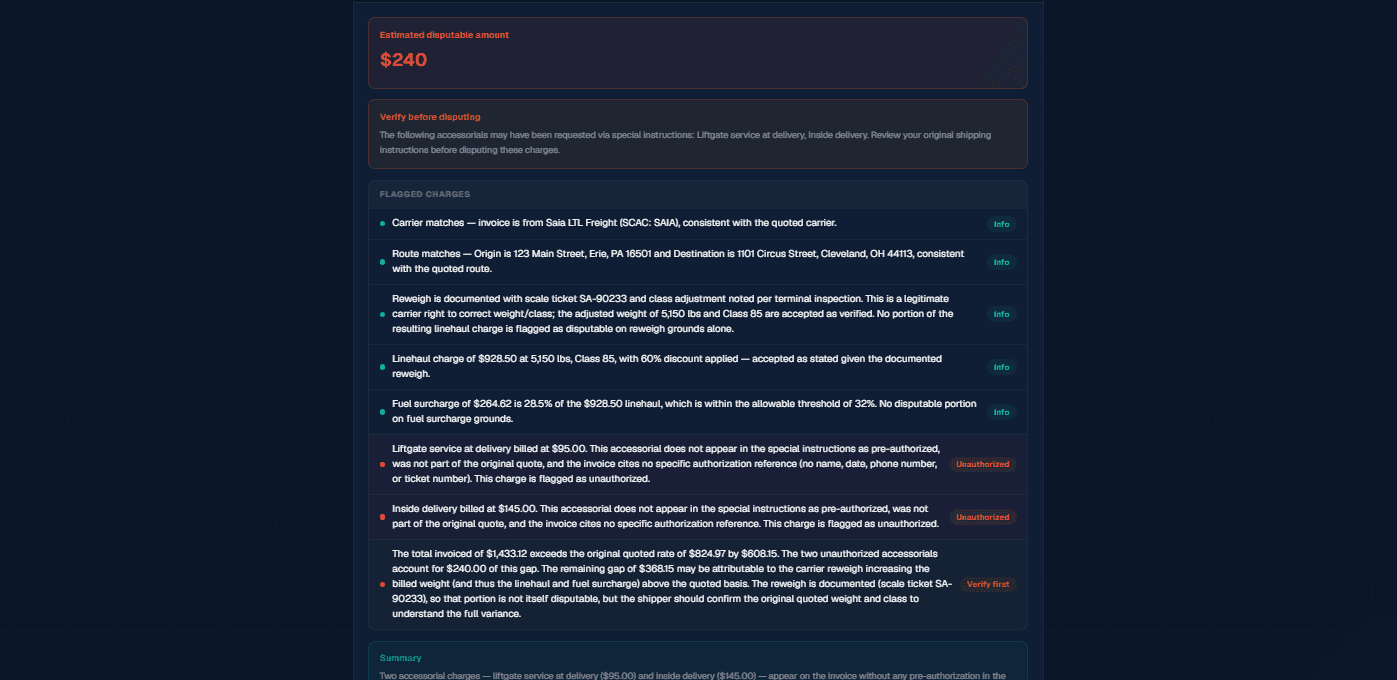
Legitimate charges, not a case against carriers
Most accessorial charges on this page are legitimate fees for real services: a liftgate did lower the freight, a driver was genuinely held past free time, a shipment really was reweighed and came back heavier. Knowing the trigger condition is what lets you tell a correct charge from an incorrect one, not a reason to assume every accessorial is a mistake. LanePilot drafts a dispute letter for the charges that do not trace back to their own trigger condition; it does not contact, negotiate with, or file anything with a carrier on your behalf. You remain the party of record and send the letter yourself.
See the rest of the platform
Freight invoice audit and overcharge recovery is where this reference feeds in: matching a carrier invoice against the original quote and drafting a dispute letter from what does not line up.
OS&D receiving for LTL freight covers the inbound side: catching over, short and damaged shipments at the dock and drafting the vendor chargeback letter.
LTL accessorial charges glossary is the plain-language, A-to-Z version of this reference: a short definition and trigger for every term, for when you just need to know what a charge on an invoice means.
Freight class calculator estimates the density-based NMFC class from a shipment's dimensions and weight, the same check that disputes a reclassification charge.
LTL Accessorial Charges You Can Actually Fight (or Skip) rates five common charges for how winnable a dispute on each one actually is.
Common questions
Why was I charged an accessorial fee?
An accessorial fee covers a service beyond standard dock-to-dock pickup and delivery: liftgate, residential delivery, limited access, detention, and similar. It is legitimate when the underlying trigger condition in the carrier's own tariff actually happened, for example the delivery address really was residential, or the driver really was held past free time. The reference above lists the trigger condition, what it is calculated on, and what evidence disputes it, for every charge covered.
What is the difference between detention, demurrage, and storage?
Three different holds on three different clocks. Detention is the driver and the truck waiting at a customer's dock past free time, billed in short increments. A second, easily confused hold applies when a trailer without its tractor is left at that same dock past free time; most LTL tariffs bill this as "detention without power" rather than a separately named "demurrage" line, though it functions the same way demurrage does in intermodal freight (equipment held at a facility, not a driver). Storage is a third clock entirely: freight sitting in the carrier's own possession, usually at its terminal, because nobody has picked it up or accepted it, billed per 100 lbs per 24 hours.
Which LTL accessorial charges are the easiest to dispute?
Reweigh, redelivery, detention, and reclassification tend to be the most winnable, because each has a specific document that supports or contradicts the charge: a scale ticket, a delivery receipt with timestamps, or a density calculation. Liftgate and limited access are the hardest, because the tariff language defining who qualifies is written broadly on purpose and the proof rarely survives the shipment. See LanePilot's fuller breakdown in LTL Accessorial Charges You Can Actually Fight (or Skip).
Do all LTL carriers charge the same accessorial fees?
No. Carriers publish their own rules tariffs, and thresholds, qualifying site lists, and pricing structures genuinely differ between them, sometimes on whether a service is even offered at all. The specific carrier's own tariff governs any given invoice; this reference describes the typical condition for each charge and says plainly where carriers diverge.
Does LanePilot dispute these accessorial charges for me?
No. LanePilot is not a freight broker and does not contact, negotiate with, or file anything with a carrier on your behalf. It compares a carrier invoice against the original quote for that shipment and drafts a dispute letter from what it finds, itemized against the quote, for you to review and send yourself. An audit needs both documents: the invoice and the original quote.
See which of these charges are actually on your invoice
Send a real outbound freight invoice and the original quote for that shipment, and LanePilot shows you what it finds. Free, no account needed.
Run a free invoice auditWant the full workflow first? See how invoice auditing works or see plan pricing.