Which LTL accessorial charges can you actually win a dispute on?
Reweigh, reclassification, redelivery, and detention charges are the most winnable, because each has a document, a scale ticket, a timestamp, a density figure, that backs up or contradicts the charge. Liftgate and limited access fees are hardest to win, because the tariff language is broad and the proof rarely survives the shipment.
Not every accessorial charge deserves the same fight. Dispute a charge the tariff clearly supports and you waste time and goodwill. Skip a charge with no basis and you leave money on the table. Below is an honest breakdown of five charges that show up after delivery, rated for how winnable each one realistically is and what proof moves it.
1. Liftgate service: hard to win, easy to prevent
A liftgate is the hydraulic platform that raises and lowers freight between the truck bed and the ground, used at locations without a loading dock. Old Dominion describes it plainly: liftgates are specialized equipment used to load or unload shipments when a location has no dock. That is why it is the accessorial that stings most. The driver offers the liftgate, the receiver takes the easier option, and nobody realizes it triggered a charge until the invoice arrives weeks later. By then the freight is unloaded and there is rarely a record either way of whether the equipment was actually needed.
Verdict: rarely winnable after delivery, easily prevented before it. The fix is not a dispute letter, it is a phone call before the shipment moves: confirm with the receiver whether they have a dock or forklift, and tell them not to accept the liftgate unless it is pre-authorized. The only real after-the-fact argument is a delivery receipt that explicitly states no liftgate was used, which is uncommon unless you specifically asked the driver to note it.
2. Limited access delivery: the broadest, hardest-to-win definition
Limited access covers pickup or delivery locations that are not a standard commercial dock. Carriers commonly list schools, military bases, guard shacks, gated properties, and unmanned storage facilities, but the category rarely stops there. One carrier-facing breakdown of the charge closes its list with hospitals, convention centers, construction sites, airports, and remote or hard-to-reach areas, framing the charge as turning on whether a site presents unusual operational challenges, not on membership in a fixed list. That is a deliberately wide net: broad language lets a carrier bill the fee for a site type nobody thought to name in advance.
Verdict: the hardest of the five to win. Once a location is billed under a limited access clause, the tariff usually, technically, supports it, even if the charge feels excessive for your specific site. Fighting it after delivery means arguing against the carrier's own definition of its own tariff, a weak position. The real defense is upstream: pull the specific carrier's limited access definition before you book a shipment to a site that might qualify, and either price the fee in ahead of time or route through a carrier whose definition is narrower.
3. Reweigh charges: winnable if you kept your own numbers
Carriers put freight on a certified terminal scale, and if the actual weight comes back higher than what was declared on the bill of lading, they rerate the shipment and bill the difference, typically alongside a separate reweigh inspection fee. A carrier is allowed to correct an inaccurate declared weight; a terminal reweigh by itself is not a red flag. What makes it disputable is documentation, or the lack of it. A legitimate reweigh should be backed by a weight and inspection record, sometimes called a W&I certificate, tied to a specific date and terminal, that overrides the original bill of lading weight.
How to check it: request that certificate or scale ticket from the carrier for the PRO number in question. If the invoice shows a higher billed weight and no certificate exists, or it does not match your shipment date, you have solid grounds to dispute. Your own shipping scale ticket, kept at the time of pickup, is the strongest evidence on your side of the argument.
Verdict: winnable when you have your own weight on record. Unwinnable when neither side has documentation, because then it is your word against a scale that, on paper, outranks your bill of lading.
4. Redelivery and detention: winnable with timestamps, lost without them
Redelivery is billed when a first delivery attempt fails and the carrier has to reschedule the truck. Detention is billed when a driver is held at a dock beyond the carrier's free time, generally 30 minutes to two hours, before the meter starts running.
Both charges live and die on the timestamps. For redelivery, the question is whether the first attempt actually failed for a reason outside your control (no one available to receive, wrong address on file) versus a reason the carrier can fairly bill for. For detention, the dispute usually comes down to when the clock started, not how long the driver eventually waited. The delivery receipt, with its arrival and departure timestamps, answers both questions.
Verdict: winnable if the delivery receipt supports your version of events. A dock log or delivery receipt showing shorter wait times than billed, or showing the first attempt was never actually made, is a specific, provable dispute. Without a timestamp on your side, it is your recollection against the carrier's invoice, and recollections lose.
5. Reclassification: winnable with a density calculation
Reclassification is not strictly an accessorial, but it lands on the invoice the same way: after the freight has already moved. The carrier reweighs or remeasures the shipment at the terminal, calculates a different density than what you booked under, and assigns a higher freight class, with the rate adjusting accordingly. LTL classification is trending toward heavier density weighting as NMFTA reviews a transition to full-scale density-based classification for more commodity groups, which makes this charge worth watching, particularly for freight that is light for its physical footprint.
How to check it: recalculate the density yourself, actual weight divided by cubic volume, the same measurement method the NMFTA classification standard uses (or run it through LanePilot's free freight class calculator), and compare your number to the billed class. If your calculation supports the original class and the carrier has no inspection report, dimension record, or photo behind the reclass, that is a quantified, specific dispute. For the fuller density-calculation walkthrough, see our guide to disputing an LTL freight reclassification.
Verdict: winnable when you kept your own dimensions at booking. Weak when you did not measure the shipment yourself and have nothing to compare against the carrier's terminal figure.
Keeping the paperwork lined up on every shipment
The pattern across all five: the winnable disputes, reweigh, redelivery, detention, and reclassification, are winnable because a specific document, a scale ticket, a timestamp, a density figure, exists to contradict the charge. The weak disputes, liftgate and limited access, are weak because the tariff language is broad on purpose and that proof was usually never captured. Deciding which is which, before the freight moves, matters more than any dispute letter. Vagueness loses either way; specifics win. None of these checks require special tools, just the original quote, the invoice, the bill of lading, the delivery receipt, and the discipline to line them up on every shipment before you pay, which is manageable for one invoice and unmanageable across a month of them.
For the general dispute process, see our LTL freight dispute letter template, for the full list of accessorial charge types, see why you were charged an accessorial fee, and for the reweigh certificate and density recalculation mechanics in more depth, see the four most common LTL invoice overcharges.
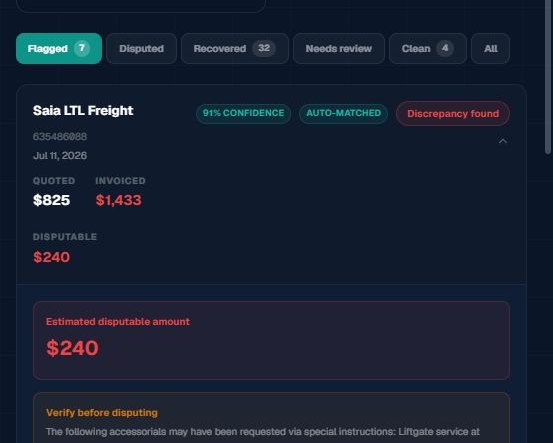
LanePilot is a shipper freight platform built for shippers who do not have a TMS or a dedicated freight team. Invoice audit and recovery is what it is best known for: it compares every delivered shipment's invoice against the original quote and shipment record automatically, flags exactly this kind of discrepancy, and drafts a dispute letter with the documentation a carrier's claims department needs. LanePilot does not send, file, or negotiate that dispute with the carrier. You remain the party of record and file it yourself. You can run a free audit with your invoice and original quote, or read more about how LanePilot works.
How automated detection actually runs the check
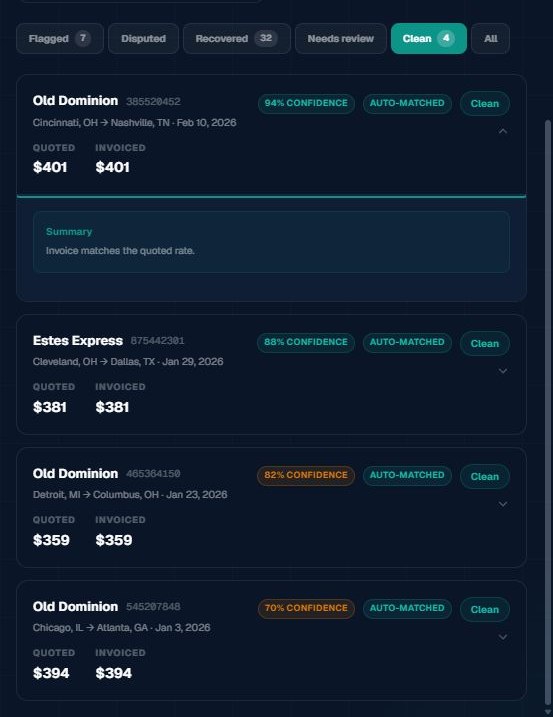
Everything above is the manual version: pull the document, compare it to the charge, dispute the gap. Running it automatically is the same comparison against the shipment record already on file, so the check happens on every invoice instead of the handful someone has time to open. It does not re-explain what each fee is (for that, see why you were charged an accessorial fee); it asks whether the fee matches what actually happened. Three matches do most of the work.
- The billed accessorial code against the shipment's delivery details. A liftgate charge is checked against whether it was actually a liftgate delivery; a limited access fee against whether the delivery address genuinely fits the carrier's limited access definition. A code that does not match the shipment on record is flagged to verify.
- The scale ticket against the billed reweigh weight. When the invoice carries a reweigh, the billed weight is compared against the weight on record for that shipment. A higher billed weight with no scale ticket or certificate behind it is the same gap the manual reweigh check hunts for, surfaced without opening the file by hand.
- The dock records against billed detention. Detention billed for time held at the dock is checked against the arrival and departure timestamps on record. Billed time that runs longer than the dock record supports is flagged for you to dispute.
Each flag is a specific, document-backed discrepancy tied to one shipment, the kind a carrier's claims department can act on rather than a vague suspicion that earns a vague denial. As everywhere else, LanePilot drafts the dispute letter from that finding, and you review it and file it with the carrier yourself.
Frequently Asked Questions
Which LTL accessorial charges are the easiest to win a dispute on?
Reweigh, redelivery, detention, and reclassification charges are the most winnable because each has a document that either supports or contradicts the charge: a scale ticket, a delivery receipt with timestamps, or a density calculation. No matching document on the carrier's side means the charge is disputable.
Can you dispute a limited access delivery fee?
Rarely with success. Carriers write their limited access definitions broadly, often including catch-all language beyond a fixed list of site types, and if your location technically fits, the tariff supports the charge even if it feels unfair. The better move is checking the carrier's definition before you book, not disputing after delivery.
Is a liftgate charge disputable after the shipment has delivered?
Rarely. Once freight is unloaded, there is usually no record of whether a liftgate was actually needed unless the delivery receipt notes it either way. Liftgate charges are much easier to prevent at booking, by confirming with the receiver whether they have a dock or forklift, than to dispute after the fact.
What proof do I need to dispute a reweigh charge?
Ask the carrier for the reweigh certificate or scale ticket tied to the PRO number. A legitimate reweigh has a certified weight, date, and terminal location on file. If the invoice shows a higher weight and no certificate exists, or your own shipping scale documentation contradicts it, the charge is disputable.