How do you write an LTL freight dispute letter?
A freight dispute letter needs six things: the PRO number, the shipment date, the specific billing error, the amount billed versus the correct amount, your supporting documents, and a clear request for a credit. Send it to the carrier's claims department promptly; how long you have varies by carrier and by your contract or bill of lading terms. A template you can copy is below.
That is the short version. The longer version is that most LTL invoices carry at least one billing error, and the letter only works if it is specific: a vague complaint gets a form-letter denial, while a letter that names the exact line item, cites the correct figure, and attaches proof gets resolved. This guide covers the general overcharge letter, for weight errors, accessorial charges, fuel surcharge miscalculations, and duplicate billing. If your issue is specifically a freight class reclassification at the terminal, see our dedicated guide on disputing an LTL freight reclassification, which walks through the NMFC density calculation those disputes require.
The Four Billing Errors a General Dispute Letter Covers
Weight discrepancies. The carrier reweighs your shipment and bills a higher weight than what is on the bill of lading. Unlike a reclassification, the freight class stays the same, only the weight bracket changes, and the rate moves with it.
Accessorial charges for services not rendered. Liftgate, residential delivery, inside delivery, or detention fees appear on the invoice for services the driver never performed, or for wait times that were shorter than billed. These are some of the easiest errors to catch because you were there and know what actually happened.
Fuel surcharge miscalculation. Fuel surcharges are supposed to track a published index, most commonly the U.S. EIA weekly diesel index. If a carrier applies last month's percentage instead of the current one, or applies the wrong regional figure, the surcharge line is overstated. It is a small percentage on paper but it compounds across every shipment on the lane.
Duplicate billing. The same PRO number gets invoiced twice, sometimes under a slightly different invoice number so it does not look duplicated at a glance. This is the easiest error to prove and the easiest for a carrier to concede once you show the two invoice numbers side by side.
The Dispute Window
Shippers have a window from the invoice date to contest a freight bill and preserve the right to challenge the charge, but how long that window actually runs varies by carrier and by your contract or bill of lading terms, so check the terms on your own bill of lading rather than assume a single number applies everywhere. 49 U.S.C. 13710 is the federal statute governing billing and collecting practices between carriers and shippers, and the same principle runs in the other direction: a carrier that wants to collect additional charges beyond what it originally billed is bound by the same kind of window.
Two details matter in practice. The clock starts on the invoice date, not the delivery date and not the day you happened to notice the error, so invoices from earlier in the year are closer to expiring than ones from last week. And carriers have no obligation to remind you the window is closing. An overcharge you never disputed simply becomes revenue the day the window shuts, no matter how clear the error was.
How to Dispute an LTL Freight Overcharge, Step by Step
- Identify the specific error. Name the exact invoice line, the exact discrepancy, and the exact dollar amount in question. Vague disputes ("this invoice seems high") get vague denials.
- Pull your supporting documents. You need the original quote or contract rate card, the bill of lading, the delivery receipt, and the disputed invoice. For an accessorial dispute, a delivery receipt with a timestamp is often the whole case.
- Calculate the correct figure. For a weight dispute, that is the correct weight bracket at your contracted rate. For a fuel surcharge dispute, recalculate the surcharge using the correct index week and percentage. Put the number in the letter, do not make the carrier do the math.
- Write the letter. Use the template below. Keep it factual, keep it short, and reference the specific charge, not the whole invoice.
- Send it to the claims department. Not billing, not the driver, not your sales rep. Confirm the correct intake address or portal before you send, since it varies by carrier.
- Follow up every 30 days. If you have not heard back, follow up in writing so there is a paper trail showing you pursued it inside the window.
- Escalate a denied claim. If a well-documented dispute is rejected, escalate in writing to the carrier's regional sales contact or billing management, and resubmit with anything that was missing the first time.
Freight Claim Dispute Letter Template
Copy this, fill in the bracketed fields, and send it to the carrier's claims department.
Date: [date]
Re: Freight invoice dispute, PRO number [PRO number]To the Claims Department,
We are disputing a billing error on the shipment below.
- PRO number: [PRO number]
- Invoice number: [invoice number]
- Shipment date: [date]
- Origin and destination: [city, state to city, state]
- Disputed charge: [e.g., liftgate accessorial, weight adjustment, fuel surcharge, duplicate invoice]
- Amount billed: [dollar amount]
- Correct amount, per [quote / contract rate / delivery receipt / recalculated index]: [dollar amount]
- Basis for dispute: [brief factual explanation, for example: "Liftgate service was not requested or performed at delivery, per attached delivery receipt" or "Fuel surcharge applied at 32%; the EIA index for the ship week supports 27%."]
We request that this charge be corrected and the difference of [dollar amount] be credited to our account. Supporting documentation is attached. Please confirm receipt and provide a resolution timeline.
[Name, title, company, contact]
Frequently Asked Questions
How do I write an LTL freight dispute letter?
Include the PRO number, shipment date, origin and destination, the specific line item in dispute, the billed amount versus the correct amount, your supporting documentation, and a clear request for a credit or rebill. Send it to the carrier's claims department, not billing or a sales rep, promptly, since how long you have varies by carrier and by your contract or bill of lading terms.
What is the deadline to dispute an LTL freight invoice?
It varies by carrier and by your contract or bill of lading terms, so check the terms on your own bill of lading rather than assume a single number applies everywhere; 49 U.S.C. 13710 is the statute that sets the frame. The clock runs per invoice regardless of when you notice the error, so older bills in a backlog are the ones to check first.
What documents do I need for a freight overcharge dispute?
The original rate quote or contract rate card, the bill of lading, the delivery receipt or proof of delivery, and the disputed invoice itself. These four documents let you show the carrier exactly where the billed amount diverges from what was agreed or delivered.
What if the carrier denies my dispute letter?
Escalate in writing to the carrier's regional sales contact or billing management and resubmit with any missing documentation. Disputes that cannot be resolved at the carrier level can be brought to the Surface Transportation Board under 49 U.S.C. 13710, though most well-documented claims resolve before that point.
Catching the Error Before the Window Closes
The hard part of a freight dispute is rarely writing the letter. It is noticing the error in the first place, on the invoice that arrived three weeks after delivery, buried among a dozen others that were correct. Manual review works for one invoice. It breaks down across a full month of shipments, and that gap is exactly where weight errors, phantom accessorials, and duplicate bills survive past your own dispute window.
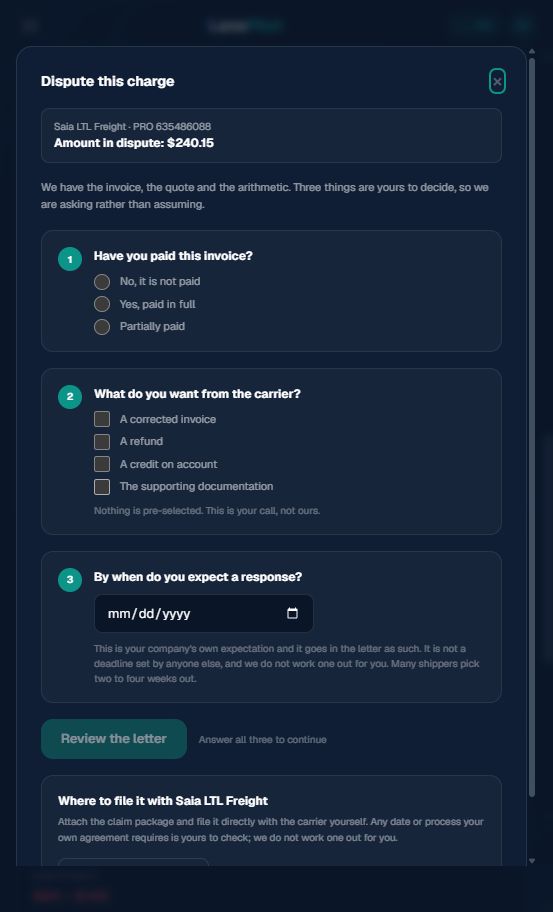
LanePilot is an LTL TMS and WMS for small to mid sized manufacturers and shippers, not a freight broker. It compares every invoice against the original quote and shipment record as soon as the bill arrives, flags the discrepancy, and prepares the documentation trail so a dispute letter like the one above is ready to send instead of waiting to be found. LanePilot does not contact carriers, file disputes, or negotiate on your behalf. It builds the dispute letter from the audit findings and you send it yourself. For the audit process in more depth, see How to Audit an LTL Freight Invoice. You can also see how it works firsthand at LanePilot.
The Bottom Line
A freight overcharge is only free money for the carrier if nobody disputes it inside the window. Pull your oldest unreviewed invoices first, check them against the four source documents, and send the letter as soon as you find a discrepancy. The math is rarely complicated. The discipline of doing it before your own window runs out is the part that recovers the money.