LTL freight invoices are wrong more often than most shippers realize. The good news: almost every error is catchable if you dispute it before your window closes. Here is how to audit an invoice line by line.
How do you audit an LTL freight invoice?
Compare each line item on the invoice against four source documents: the original quote, the Bill of Lading, the carrier's delivery receipt, and your contract rate card or tariff reference. Any discrepancy in freight class, weight, accessorial charges, or discount application is a potential billing error with a dispute right. How long that dispute window runs varies by carrier and by your contract or bill of lading terms, so check the terms on your own bill of lading rather than assume a single number applies everywhere.
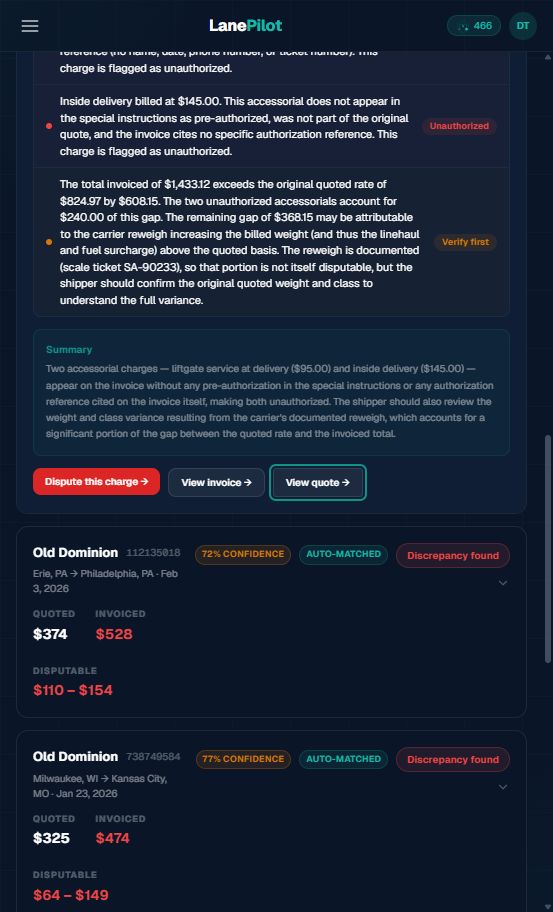
That cross-reference is the whole audit in one sentence, but it only works if you have the four documents and know what each is supposed to prove. LTL invoices carry errors because the price is assembled from several moving parts (class, weight, lane, accessorials, fuel), and each is a chance for a mismatch. Most errors go uncaught for a simple reason: the invoice arrives weeks after delivery, the person who booked the load has moved on, and nobody pulls the original quote to compare. Now that the NMFC moved to density-based classification on February 6, 2026, terminal reclassifications are the single most common error, and with accessorials now a large and growing share of the bill, the dollars at stake per invoice are larger than they used to be. The ROI on a five-minute audit has never been higher.
What are the most common LTL invoice billing errors?
- Freight class reclassification at the terminal. Since NMFC density-based enforcement went live on February 6, 2026, this is the most frequent error: the carrier re-measures your freight, assigns a higher class, and bills the difference.
- Weight discrepancy from a terminal reweigh. The carrier puts your pallet on a certified scale, comes up heavier than the BOL, and rerates the shipment.
- Accessorials billed for services not delivered: liftgate, residential, or detention charges that never actually happened.
- Fuel surcharge at the wrong percentage, applied off a stale table instead of the current U.S. EIA diesel index.
- Duplicate invoice for the same PRO number: the same shipment billed twice.
What documents do you need to audit a freight invoice?
- The original freight quote (carrier- or platform-generated, showing freight class, rate, and lane).
- The Bill of Lading (commodity description, declared weight, declared class).
- The delivery receipt or POD, with timestamps, critical for detention disputes.
- The carrier tariff or contract rate card in effect on the ship date.
Most shippers do not keep these systematically, which is exactly why errors slip through. If a document is not on file, request it from the carrier's billing or claims department: quote the PRO number and ask for the rated invoice detail, the weigh-in record behind any reclassification, and the signed delivery receipt. Carriers are obligated to provide the documentation behind a charge.
How do you dispute an LTL invoice overcharge?
- Identify the specific discrepancy: the exact invoice line versus the BOL versus the original quote.
- Assemble supporting documentation: BOL, delivery receipt, original quote, and contract reference.
- Write the dispute letter with the PRO number, invoice number, billed amount, contracted or quoted amount, and the basis for the dispute, citing the relevant tariff rule or NMFC classification code.
- Submit to the carrier's billing-dispute or claims department promptly. How long you have varies by carrier and by your contract or bill of lading terms, so check the terms on your own bill of lading rather than assume a single number applies everywhere.
- Follow up at 30-day intervals if you do not receive a written response.
What is the deadline for disputing a freight invoice?
It varies by carrier and by your contract or bill of lading terms, so check the terms on your own bill of lading rather than assume a single number applies everywhere. Carriers rarely advertise it, because an unchallenged charge becomes revenue once the window closes and your dispute right is extinguished. There is added urgency for Q1 2026 shipments caught up in the NMFC reclassification rollout: those invoices are aging toward their own cutoff now, and a reclass you never disputed is money you simply forfeit. If you suspect a backlog of unaudited invoices, work the most recent ones first and move backward before the oldest fall out of the window.
Stop auditing one invoice at a time
Manual auditing works, but it only scales as far as your attention does. LanePilot's invoice audit compares every delivered shipment's invoice against its original quote automatically, flags the freight-class, weight, accessorial, and fuel discrepancies, and gives you the documentation trail for a dispute, so the overcharges you have been leaking get caught before your window closes. The same audit-against-quote approach also recovers money on inbound freight: see the inbound freight audit blind spot. If you also want to stop overpaying at the quote stage, see How to Compare LTL Carriers Without a TMS. For disputes you cannot resolve with the carrier, the Surface Transportation Board provides an escalation path under 49 U.S. Code 13710.