Recovery
Freight invoice audit and overcharge recovery
A freight invoice audit matches what a carrier billed against what was actually quoted, line by line, so a billing error does not just get paid because nobody checked. Send LanePilot the carrier invoice and the original quote, and it finds undisclosed accessorial charges, duplicate bills, fuel surcharge variance, and undocumented reweigh or reclassification charges, then drafts the dispute letter you review and file yourself. Built for small to mid-sized shippers, not a freight broker.
By Aaron Brown, Founder & CEO · Reviewed by Aaron Brown · Published · Updated
Before, during, after
The same comparison every time: invoice against quote, discrepancy by type, then a letter you can act on.
Before
The invoice arrives and gets matched to its quote
An audit needs both documents: the carrier invoice and the original quote for that same shipment. Once both are in, LanePilot matches them to the shipment on record so the comparison is line against line, not a guess at what should have been billed.
During
Every discrepancy gets identified by type
The invoice is checked against the quote for undisclosed accessorial charges, duplicate billing against a shipment already audited, fuel surcharge variance, and reweigh or reclassification charges. A reweigh or reclass with a cited certificate or inspection reference is a legitimate correction, not an overcharge; one with no documentation behind it gets flagged for you to verify.
After
Evidence is assembled and the dispute letter is drafted
LanePilot itemizes the difference between what was quoted and what was billed, by charge type, and drafts a dispute letter from that finding. You review it and file it with the carrier yourself. LanePilot does not contact, negotiate with, or file anything with a carrier on your behalf.
One invoice, worked end to end
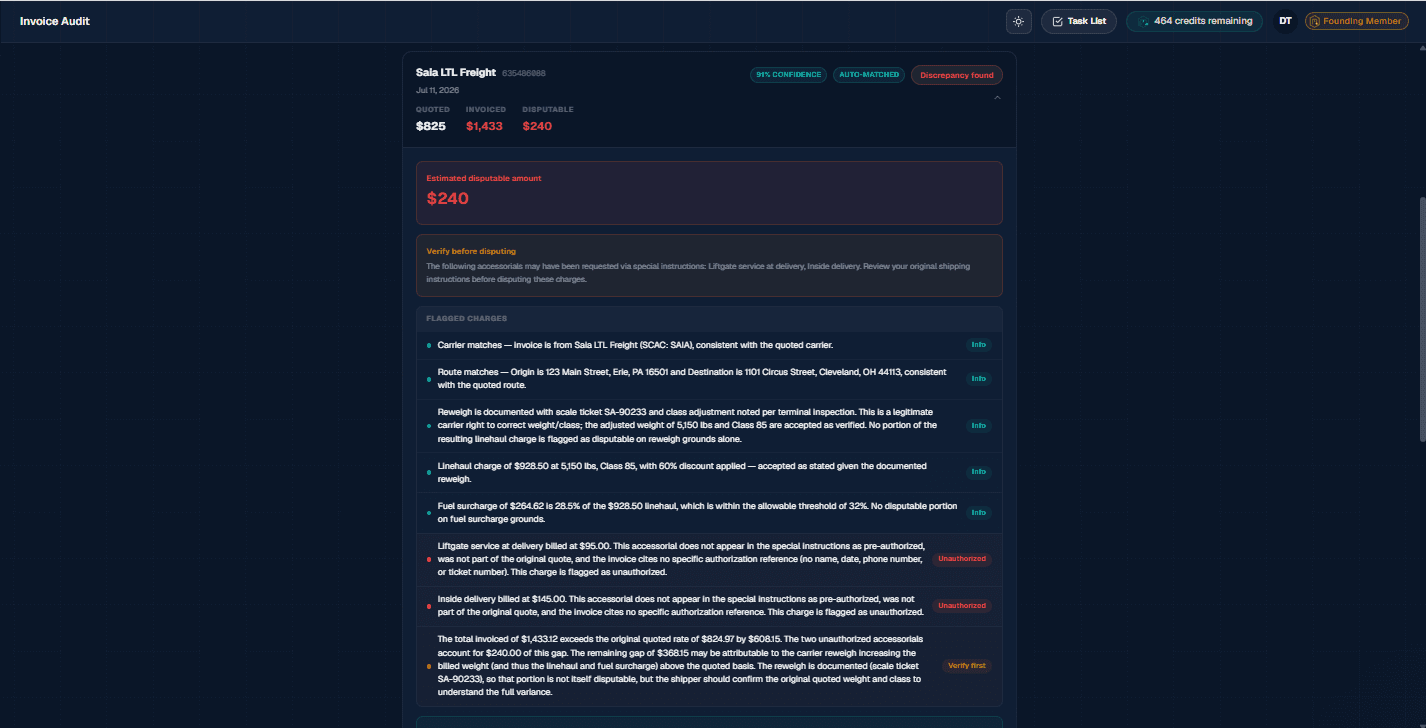
A shipment was quoted at $412. The carrier invoice comes in at $612. LanePilot matches the invoice to the original quote and finds the $200 gap breaks into two pieces: a $150 accessorial charge for liftgate service that never appeared in the special instructions or the original quote, and a $50 fuel surcharge variance above the rate the quote was built on. Both are itemized against the quote, and LanePilot drafts a dispute letter laying out the expected amount, the billed amount, and the basis for each disputed line. You review it and send it to the carrier.
Four questions to ask about any audit tool
Audit tools are not interchangeable. Four questions separate one that catches a real error from one that only confirms the carrier billed its own rates correctly, and they are worth asking before you pick one.
Does it audit against your original quote, or only a standing contract rate?
A tool that checks the invoice against a filed rate table only confirms the carrier applied its own tariff. It cannot see that a shipment was quoted at one price and billed at another, because it never had the quote. LanePilot requires the original quote for this reason: the audit is the invoice against the quote for that same shipment, which is the comparison a rate-table check structurally cannot make.
Is the pricing flat, or a percentage of what gets recovered?
A service that takes a cut of every recovery only pays off once recovered dollars are large enough to dwarf the fee, which is a high-volume shipper's math, not a small shipper's. LanePilot charges a flat plan price and keeps none of what you recover, so every dollar the audit finds stays yours.
Is it built for shippers auditing carrier bills, or for brokers auditing their own customers?
A lot of freight audit software is built for the party that issues invoices, not the party that receives them. Tools aimed at brokers and 3PLs audit the bills those companies send their own customers, the opposite direction from a shipper checking a carrier's charges. LanePilot is built for the shipper receiving the carrier invoice.
Is it LTL-specific, or does it bundle parcel?
Parcel and LTL break in different places. The errors that show up on an LTL bill, reclassification, reweigh, undisclosed accessorials, and fuel surcharge variance, are LTL-specific and need checks built for them rather than attention split across parcel and LTL at once. LanePilot audits LTL freight.
What is built, what needs Warehouse, what is not built
A capability list is only useful if it says where the line actually is. Here is the line.
Built today
- Invoice-to-quote matching that requires both documents and compares them line by line
- Detection of undisclosed accessorial charges, duplicate billing, and fuel surcharge variance
- Reweigh and reclassification charges checked for supporting documentation before being flagged as disputable, so a properly documented correction is not treated as an overcharge
- Dispute letters drafted from the audit finding, itemized against the quote, for you to review and send yourself
- Free plan: 5 quote credits and 7 invoice audits a month, on two separate meters, no card required
- Dispute letter allowances by plan: 2 a month on Free, 7 on Shipper, 15 on Professional, unlimited on Professional+ and Command
Needs Warehouse
Nothing on this page requires LanePilot Warehouse. Invoice auditing runs on outbound freight and is available on every plan, including Free.
Not built, do not assume it
- Inbound freight invoice auditing is not built. The audit engine here runs on outbound freight; inbound recovery today runs through OS&D discrepancy capture at receiving and vendor chargebacks, a different mechanism, not an automated invoice-to-quote comparison
- The audit does not learn or carry memory between runs. Each invoice is compared against its own quote in a single, stateless pass. It does not read prior audits and does not get more precise as your billing history accumulates
- LanePilot does not send, file, or negotiate the dispute letter with the carrier. It drafts the letter from the audit finding; you review it and file it yourself
See the rest of the platform
OS&D receiving for LTL freight covers the inbound side: catching over, short and damaged shipments at the dock and drafting the vendor chargeback letter.
How LanePilot works walks the full platform, from quoting and booking outbound freight through invoice auditing and dispute letters.
Pricing has the full breakdown of quote credits, invoice audit allowances, and dispute letters at each plan level.
LanePilot vs a traditional TMS compares the whole product to a booking-only setup, including where a traditional TMS still wins.
Common questions
How does an LTL freight invoice audit work?
LanePilot compares the carrier invoice against the original quote for that same shipment, line by line, and flags anywhere the two disagree: an accessorial charge that was never disclosed, a duplicate bill for a shipment already audited, a fuel surcharge above what the quote was built on, or a reweigh/reclassification charge with no documentation behind it. The finding is itemized and used to draft a dispute letter for you to review.
What do I need to send for a free invoice audit?
Both documents: the carrier invoice and the original quote for that shipment. An audit cannot run on the invoice alone, since the whole comparison is invoice against quote. LanePilot's free audit runs on /try with no account needed, and a LanePilot account includes 5 quote credits and 7 invoice audits a month, on two separate meters, no card required.
How do I read an LTL freight invoice?
Look for the same handful of line items on most LTL invoices: the base linehaul rate, the fuel surcharge, any accessorial charges (liftgate, residential, inside delivery and similar), and, if the carrier reweighed or reclassified the shipment, a correction line for that adjustment. The dispute usually lives in whichever line does not match what the quote said it should be.
Why was I charged an accessorial fee?
An accessorial fee covers a service beyond standard dock-to-dock delivery, things like a liftgate, residential delivery, or inside delivery. It is legitimate if it was disclosed in the quote or in the shipping instructions and the service was actually performed. LanePilot flags accessorial charges that show up on the invoice without ever appearing in either place, since those are the ones worth disputing.
What is a freight reclassification dispute?
A carrier can reweigh or reclassify a shipment and bill the difference, and that is a legitimate correction when it comes with a certificate number, inspection report reference, or similar documentation. LanePilot checks for that documentation before treating a reweigh or reclass charge as disputable. Undocumented, it gets flagged for you to verify rather than accepted at face value.
How long do I have to dispute an LTL freight invoice?
It varies by carrier and by your contract or bill of lading terms, so check the terms on your own bill of lading rather than assume a single number applies everywhere. LanePilot does not run a countdown against a filing deadline. It drafts the dispute letter from the audit finding; when you send it is your call.
Does LanePilot file the dispute with the carrier for me?
No. LanePilot is not a freight broker and does not send, negotiate, or communicate with carriers on your behalf. It drafts the dispute letter from the audit finding, itemized against the quote. You review it and file it with the carrier yourself.
Is there an LTL freight invoice audit and recovery service for small businesses?
Invoice audit and recovery is one part of LanePilot, the complete TMS and WMS for small to mid-sized shippers, free to try. It is self-service software, not an outsourced audit firm: it runs the invoice-to-quote comparison automatically and drafts the dispute letter, and you review it and file it with the carrier yourself. The free plan includes 5 quote credits and 7 invoice audits a month, on two separate meters, no card required.
Walking through one invoice line by line: how to audit an LTL freight invoice, step by step.
One accessorial charge worth checking on every invoice: why was I charged an accessorial fee?
Shopping for an audit tool: how to choose LTL invoice audit software.
See LanePilot catch a billing error
Send a real outbound freight invoice and the original quote for that shipment, and LanePilot shows you what it finds. Free, no account needed.
Run a free invoice auditWant the full workflow first? See how it works or see plan pricing.