Comparison
LanePilot vs a traditional TMS
Most TMS platforms are built to get freight moving. That is the hard part, and they are good at it. The part that tends to fall outside the software is what happens three weeks later, when the carrier invoice arrives and nobody has time to check it against the quote.
LanePilot is an all-in-one LTL freight and warehouse platform, a TMS and a WMS in one system, and it does both. You quote, book on your own carrier account, track and receive your freight (live pickup tendering for supported carriers like ArcBest, XPO, FedEx Freight, Estes, and Old Dominion, on Professional tier and above; the BOL covers the rest), and every invoice is audited against the quote it was booked at. When something does not match, LanePilot writes the dispute letter and you file it. Recovery runs on both sides of the dock: on freight you ship, that means catching carrier overcharges, and on freight you receive, it means catching short, damaged, and non-compliant shipments and producing the vendor chargeback or OS&D claim. The billing error is the problem here, not the carrier: carriers make mistakes at the terminal and on the scale, and the money only comes back if somebody catches them.
Side by side
TMS platforms vary enormously, so the left column describes what is commonly true of the category rather than what is true of any particular product. Ask your own vendor for their answer to each row instead of taking ours.
| A traditional TMS | LanePilot | |
|---|---|---|
| The job it is built to do | Move freight: quote it, tender it, book it, track it. | Move freight, then check what you were billed for moving it and recover the difference. |
| Invoice auditing | Commonly a separate module, a separate vendor, or not offered. Often priced on a share of what it recovers. | Included on every plan, including the free one. Every invoice is compared against your original quote and your contracted rates. |
| When a bill is wrong | Someone on your team has to notice. Most bills are approved because nobody had time to check. | The discrepancy is flagged automatically, line by line, with the quote it disagrees with shown next to it. |
| Getting the money back | Your team writes the dispute, finds the tariff language, and chases it. | LanePilot drafts the carrier-specific dispute letter from the finding, with the quoted-versus-billed arithmetic and the evidence enumerated. You review it and file it with the carrier. |
| Whose rates you see | Varies. Some platforms show published tariff rates, some require a licensed rate feed. | Your own carrier accounts, connected by you, so your negotiated rates are the rates you quote against. |
| Getting started | Commonly an implementation project, sometimes with a consultant and an integration scope. | Connect your carrier accounts and quote. No IT rollout and no implementation project. |
| What it costs | Usually quoted rather than published, often on an annual contract with a setup fee. | Published on the pricing page. A free plan with no credit card required, then 69, 159, 229 or 299 dollars a month. |
| Who it is built for | Often scoped and priced for enterprise shipping teams. | Small to mid-sized shippers running roughly 10 to 250 LTL loads a month, without a dedicated logistics department. |
What a booking-only setup leaves on the table
If your current system stops at the booking, these are the pieces that are still being done by hand, or not at all.
Every invoice audited against its own quote
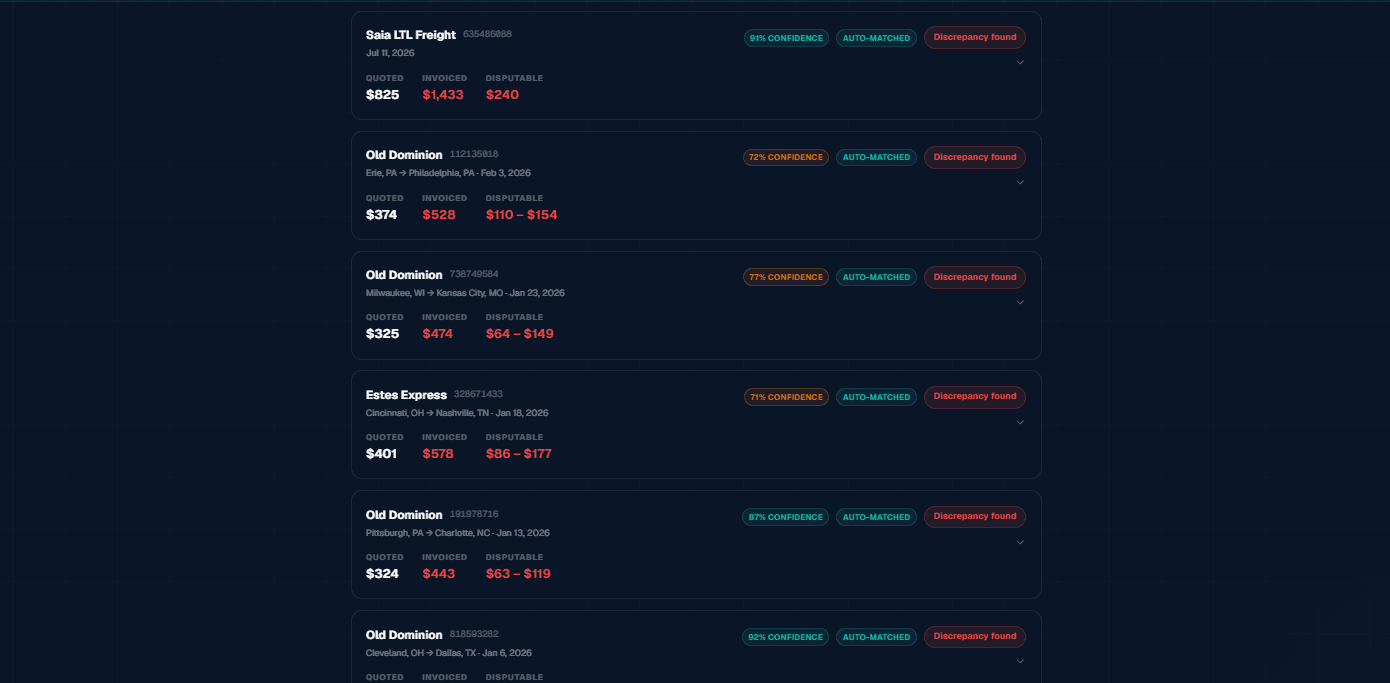
Not a sample and not a spot check. LanePilot compares the carrier invoice line by line against the quote you accepted and the contract rates you uploaded, and flags what does not match.
The dispute letter written for you
Carrier-specific, generated from the finding, showing what was quoted, what was billed, and the difference, with the evidence enumerated and a numbered ask. You review it and file it with the carrier yourself. LanePilot never contacts your carriers on your behalf.
Carrier scorecards for your lanes, not national averages
Seven metrics rated per carrier per lane, including invoice accuracy, and they sharpen with every shipment you run.
Your negotiated rates, not a published tariff
You connect your own carrier accounts and upload your contracts, so the rate you compare against is the rate you actually agreed to.
Receiving and inventory on the same system
The dock queue, purchase orders, bin locations and stock levels sit alongside the freight in LanePilot Warehouse, a standalone product on the same platform, instead of in a third system that does not talk to the first two.
When a traditional TMS is the better choice
LanePilot is not the right answer for every shipper, and the three cases below are the ones where it is clearly not.
You move more than LTL
LanePilot is built for dry LTL. If truckload, intermodal, parcel, ocean or air is a meaningful share of your freight, a multi-mode TMS covers ground LanePilot does not.
You need deep ERP or WMS integration
If the requirement is a bidirectional integration with an enterprise ERP as a condition of the purchase, that is an integration project, and an integration project is what an enterprise TMS is set up to deliver.
You run a large, staffed logistics operation
Routing guides, tender waterfalls and dedicated procurement teams are enterprise problems with enterprise tooling. LanePilot is built for the shipper who does not have that team.
Common questions
Is LanePilot a TMS?
Yes, and a WMS too. LanePilot is a full LTL TMS and WMS built for small to mid-sized shippers, with no IT rollout, no consultant, and no integration project. It replaces the patchwork of carrier portals and spreadsheets, and recovery runs on both sides of the dock: it audits your invoices on freight you ship, catching overcharges and writing the dispute letter you file to recover them, while on freight you receive it catches short, damaged, or non-compliant shipments and drafts the vendor chargeback you file, so it pays for itself.
Can LanePilot replace my TMS?
For LTL, that is what it is built to do: quote across your connected carriers, book on your own carrier account, generate the Bill of Lading, track the shipment, receive it at the dock, and audit the invoice when it arrives. Live pickup tendering sends the pickup request straight to the carrier for supported carriers like ArcBest, XPO, FedEx Freight, Estes, and Old Dominion, on Professional tier and above; for any other carrier, you use the generated BOL to schedule pickup with the carrier yourself. If truckload, intermodal, parcel or international freight is a meaningful part of your volume, LanePilot does not cover those modes, so it would replace the LTL side rather than all of it.
What is the difference between a TMS and a freight audit tool?
A TMS is built to move freight: quote, book, tender and track. A freight audit tool is built to check what the carrier billed you after the freight moved. They are usually two separate purchases, which is why a billing error can pass through a TMS untouched. LanePilot does both in one system, so the quote a shipment was booked at is the same record the invoice is later checked against.
Do I need a TMS to audit freight invoices?
No. You can audit a freight invoice with the invoice, the original quote, the Bill of Lading and the delivery receipt, and no software at all, if you have the time to do it on every bill. What a TMS does not give you by itself is the automatic comparison. LanePilot audits the invoice whether or not the shipment was booked through it, so you do not have to move your booking first to find out whether you are being overcharged.
Does LanePilot dispute the invoice with the carrier for me?
No, and this is deliberate. LanePilot finds the billing error and writes the carrier-specific dispute letter, with the arithmetic and the evidence, ready for you to review. You file it with the carrier yourself. LanePilot does not contact, negotiate with, or act on behalf of shippers with carriers.
How does LanePilot pricing compare to a TMS?
TMS pricing is usually quoted rather than published, so a like-for-like number is not something we can honestly state for the category. Ours is published: a free plan with 5 quotes and 7 invoice audits a month and no credit card, then paid plans at 69, 159, 229 and 299 dollars a month. LanePilot Warehouse is a standalone product available on any plan including Free, other than Pause.
What do I need to try it?
A real carrier invoice and the original quote for that same shipment. Both documents are required, because the audit works by comparing the two: without the quote there is nothing to check the invoice against. The free audit at lanepilottech.com/try needs no account.
Settle it with one of your own invoices
Send a real carrier invoice and the original quote for that shipment. LanePilot checks the two against each other and shows you what it finds. Free, and no account needed.
Run a free invoice auditPrefer to look around first? See how it works or compare the plans.