What is a freight bill audit?
A freight bill audit checks a carrier's invoice line by line against your original quote and shipment paperwork to confirm every charge is accurate. It compares freight class, weight, accessorials, and fuel surcharge on the bill against what you actually booked and shipped, and flags any mismatch so you can recover it.
LanePilot is an LTL TMS and WMS for small to mid sized manufacturers and shippers, not a freight broker. This guide covers what an audit checks, why it matters, and the step-by-step process to run one yourself. The same audit-against-quote logic recovers money on freight you receive, not just freight you ship: see the inbound freight audit blind spot for that side of the dock.
Why a freight bill audit matters
Freight billing is assembled from several moving parts, each priced separately and each a chance for a mismatch: freight class, the weight the carrier measures at the terminal, whichever accessorial services get applied, and a fuel surcharge that changes weekly. A quote reflects what you told the carrier before pickup. An invoice reflects what the carrier decided after the freight was in their hands. When those numbers diverge and nobody checks, the difference is paid without question.
That gap is not rare. Billing errors are common across LTL freight, and a thorough freight bill audit routinely recovers money that would otherwise be paid without question. That money is owed back to you, and it only comes back if someone asks inside a legal deadline that does not wait for you to notice.
The most common LTL billing errors
An audit is only useful if you know what you are actually looking for. Five errors account for most of what shows up on a mismatched invoice:
- Freight class reclassification. The carrier re-measures and re-weighs your shipment at the terminal and assigns a higher NMFC class than quoted, then bills the difference. This has grown more common since the NMFTA moved classification from commodity-based to density-based, starting with Docket 2025-1 in July 2025 and continuing with Docket 2026-1, effective February 6, 2026 (NMFTA public docket files; summarized by Old Dominion). Density is now the primary input a carrier's system checks, so shipments that used to book cleanly are more exposed to reclassification at the dock than before 2025.
- Weight discrepancy. A terminal reweigh on a certified scale comes back higher than the weight declared on the Bill of Lading, and the rate is recalculated upward from there.
- Accessorial charges for services not rendered. Liftgate, residential delivery, inside delivery, or detention fees appear on the invoice for services that were never requested, or never actually performed at the dock.
- Fuel surcharge miscalculation. Fuel surcharges are supposed to track a published index, most commonly the U.S. EIA weekly diesel index. A stale table, wrong week, or wrong percentage overstates the surcharge line on every shipment it touches.
- Duplicate billing. The same PRO number gets invoiced twice, sometimes under a different invoice number so the duplication is not obvious at a glance.
None of these require bad faith on the carrier's part. Reweighs happen, density calculations shift, and accessorial codes get applied by whoever is closest to the freight that day. The audit's job is not to assign blame, it is to catch the mismatch before the window to fix it closes.
Why you need both the invoice and the original quote
A freight bill audit cannot be done from the invoice alone. The invoice only tells you what the carrier decided to charge after the fact. The only way to know whether that number is right is to compare it against the original quote, the document that recorded the freight class, rate, and lane you actually booked. Without the quote, you are checking the invoice for internal consistency, not for accuracy.
In practice, an audit needs four documents on file for every shipment: the original quote (freight class, rate, and lane at booking), the Bill of Lading (declared weight, class, and commodity description), the delivery receipt (what accessorial services were actually performed, with a timestamp), and the invoice itself.
If any one of those is missing, the audit stalls. A quote without an invoice tells you nothing about what you were actually billed. An invoice without a quote gives you a number with no reference point to check it against. This is a hard requirement, not a nice-to-have: an audit built on half the paperwork is a guess, not a finding, and a dispute filed on a guess gets denied.
How to run a freight bill audit, step by step
- Pull all four documents. If any is missing, request it from the carrier's billing department; carriers are obligated to provide the paperwork behind a charge.
- Compare freight class on the invoice against the Bill of Lading and quote. A higher invoice class is a reclassification and a potential dispute.
- Compare billed weight against the declared weight. A higher figure without a reweigh certificate on file is a red flag on its own.
- Check every accessorial line against the delivery receipt. A charge with no matching service on the receipt is a billing error.
- Recalculate the fuel surcharge against the EIA index for the correct week. The wrong week or region overstates it.
- Check the PRO number against your invoice log to rule out duplicate billing.
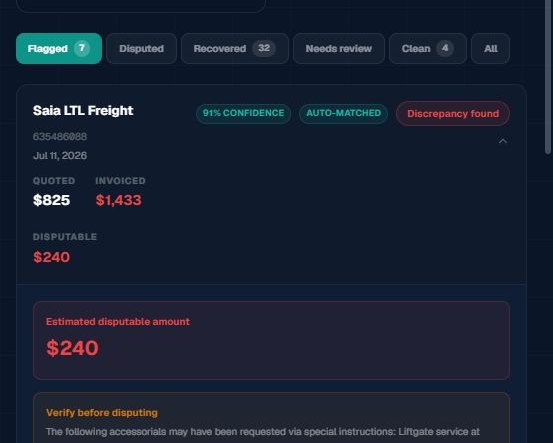
- Flag every discrepancy with the specific line, amount billed, and amount owed. That specificity turns a suspicion into a documented finding.
Each step takes only a few minutes on a single invoice. The real constraint is whether someone has the time to repeat it on every invoice that arrives, without the check quietly narrowing to only the bills that look obviously wrong. For a deeper line-by-line walkthrough, see How to Audit an LTL Freight Invoice.
What to do once you find an error
Finding a discrepancy is only half the job. The next step is filing a dispute before your window closes. How long you have to contest a bill varies by carrier and by your contract or bill of lading terms, so check the terms on your own bill of lading rather than assume a single number applies everywhere, and the same is true in reverse for a carrier billing additional charges beyond what it originally invoiced. Either way the clock runs from the invoice date, not the delivery date, so older invoices in a backlog are the ones to check first.
A dispute needs to name the exact discrepancy: PRO number, invoice number, amount billed, amount owed, and the document that proves it. Vague disputes get vague denials. Our guide to disputing an LTL freight invoice and dispute letter template walk through what to include and where to send it.
LanePilot generates that dispute letter from the shipment record it already has, but the shipper files it themselves. LanePilot does not send, negotiate, or communicate with carriers on a shipper's behalf, and holds no brokerage license to do so. You remain the party of record on every dispute.
How to choose a freight bill audit service
If manual review stops keeping pace and you start weighing software or a service to run these checks for you, four questions separate a tool that catches real errors from one that only confirms the carrier billed its own rates correctly.
- Does it audit against your original quote, or only against a standing contract rate? A tool that checks the invoice against a filed rate table confirms the carrier applied its own tariff. It cannot see that a shipment was quoted at one price and billed at another, because it never had the quote. Auditing against the quote for that specific shipment is the check a rate-table comparison structurally cannot make.
- Is the pricing flat, or a percentage of what gets recovered? A service that takes a cut of every recovery only pays off once recovered dollars are large enough to dwarf the fee, which is a high-volume shipper's math. For a smaller shipper, a flat price keeps the recovery yours.
- Is it built for shippers auditing carrier bills, or for brokers and 3PLs auditing their own customers? A lot of freight audit software is built for the party that issues invoices, not the party that receives them. Auditing the bills a broker sends its own customers runs in the opposite direction from a shipper checking a carrier's charges, and the two need different checks.
- Is it LTL-specific, or does it bundle parcel? Parcel and LTL break in different places. Reclassification, reweigh, undisclosed accessorials, and fuel surcharge variance are LTL-specific errors that need checks built for them, not attention split across a parcel bill and an LTL bill at once.
LanePilot is built for the LTL side of each: it audits the carrier invoice against the original quote for that same shipment, on a flat plan price with no cut of what you recover, for shippers checking their own carrier bills. That is why the audit requires the quote, not just the invoice.
When manual auditing stops scaling
Everything above works, and it costs nothing but time. It also has a ceiling. A shipper moving a handful of LTL shipments a week can audit every invoice by hand without much strain. A shipper moving dozens or hundreds cannot, not because the process changed, but because the time required grows with volume while the hours in a week do not. That is the point where audits quietly narrow to a sample, and errors below it get paid without a second look.
If that describes where you are, the next step is running the same checks on every invoice automatically instead of on a sample. See Freight Bill Audit and Payment Automation for further reading on automating the process above once manual review stops keeping pace with your volume, or see how LanePilot's invoice audit runs on every delivered shipment. You can also try a real lane to see a quote-to-invoice comparison directly, or read the full freight invoice audit and overcharge recovery overview.
Frequently Asked Questions
What is a freight bill audit?
A freight bill audit checks a carrier's invoice against the original quote and shipment paperwork to confirm every charge, including freight class, weight, accessorials, and fuel surcharge, matches what was actually booked and shipped. Any mismatch is a potential billing error you can dispute.
Can you audit a freight invoice without the original quote?
No. The invoice alone only shows what the carrier decided to charge after the fact. Without the original quote, there is no reference point to confirm the freight class, rate, and lane on the invoice match what you booked, so the comparison an audit depends on cannot happen.
What is the deadline to dispute a freight bill audit finding?
It varies by carrier and by your contract or bill of lading terms, so check the terms on your own bill of lading rather than assume a single number applies everywhere. The same principle applies in reverse: a carrier's own window to invoice additional charges is set the same way. The clock runs per invoice, so older bills in an unaudited backlog are the ones to check first.
Does a freight bill audit mean disputing the carrier directly?
The audit only identifies the discrepancy. Filing the dispute is a separate step, and it is the shipper's responsibility to submit it to the carrier's claims department. LanePilot generates the dispute letter and documentation but does not send, negotiate, or communicate with carriers on a shipper's behalf.