How does LTL carrier billing error detection actually work?
LTL carrier billing error detection works by comparing every charge on an invoice, weight, class, accessorials, fuel surcharge, against the original quote and shipment record for that specific load, field by field, then flagging anything that does not match. It only works if every invoice gets checked this way, not just a sample.
LanePilot is the LTL TMS for small shippers, the system of record for your freight, not a freight broker TMS like the discontinued LoadPilot. This piece is about the mechanics behind that field-by-field matching, the data it depends on, and why checking every invoice line separately catches errors that a manual, total-focused review tends to miss. For a rundown of the error types themselves, see what an LTL billing error actually is; this article goes deeper on how detection finds them.
Why comparing invoice totals doesn't catch billing errors
The fastest way to miss a billing error is to compare the bottom-line total on an invoice against a budget, a prior month's average, or a gut sense of whether the number looks right. Totals hide errors two ways. A single error inside an otherwise normal-sized invoice does not move the total enough to stand out, and, more often, two errors partially cancel out: an under-billed accessorial and an over-billed reweigh can land close to what the invoice would have totaled anyway, so nothing about the total looks wrong even though two separate lines are.
Real detection works at the line level. Every invoice is decomposed into its individual charges, base rate, freight class, billed weight, each accessorial code, and fuel surcharge, and each one is checked against its own source of truth rather than against the invoice's total.
The four records detection depends on
Line-level checking only works if the reference data exists before the invoice arrives: the original quote (freight class, rate, and lane at booking), the Bill of Lading (declared weight and class), the delivery receipt (which accessorial services were actually performed, with a timestamp), and the invoice itself once it comes in. This is the same logic accounts payable teams call a three-way or four-way match: the review stays grounded in source documents instead of the invoice total or memory of how the shipment went.
We cover pulling and comparing these four documents by hand in Freight Bill Audit: The Complete Guide for LTL Shippers. What follows here is what the comparison has to check for each charge type, the part a side-by-side glance tends to miss.
The detection logic, charge by charge
Weight and freight class: recompute the density, do not just compare labels
Since NMFC Docket 2025-1 took effect on July 19, 2025, freight class is graded primarily on density, weight divided by cubic volume, rather than commodity type, with further density-scale updates continuing through 2026. Carriers measure that density at the terminal with their own scales and dimensioning equipment, and NMFTA itself notes that shippers often use dimensioners that measure less accurately than the carrier's own equipment. That gap is why a reclassification cannot be verified by comparing the class label on the quote to the class label on the invoice. Real detection recomputes the density from the shipment's actual declared weight and dimensions, checks whether a reweigh or remeasurement certificate supports the new figure, and only then treats the reclass as legitimate. A relabeled class with no certificate behind it is a flag, not a settled fact. More on this shift in NMFC density-based reclassification: what changed in 2026.
Fuel surcharge: recompute it, do not eyeball it
Fuel surcharges are a percentage tied to a published index, most commonly the U.S. EIA weekly diesel index, mapped to the carrier's own surcharge table for that week and region. Because the index changes weekly, a surcharge line cannot be validated by whether the percentage looks familiar. Detection means pulling the published index value for the invoice's ship date, applying the carrier's own published surcharge table, and comparing the result to the billed line. Anything that does not match the recomputed figure is a discrepancy, not a rounding difference.
Accessorial charges: match the code to the delivery record, not to an assumption
An accessorial charge, liftgate, residential, inside delivery, detention, is either backed by a matching entry on the delivery receipt with a timestamp, or it is not. Detection here is a record match, not a judgment call about whether a fee seems typical for the lane. Our guide to why you were charged an accessorial fee walks through what a legitimate entry looks like for each code.
Duplicate billing: match by shipment ID, not invoice number
Carriers sometimes reissue an invoice under a new or modified invoice number to add a missed charge, and a system that only tracks invoice numbers treats the reissue as a new bill instead of the same shipment billed twice. Reliable detection keys every invoice to the shipment-level PRO number first, invoice number second, so a reissue under a different number still gets caught.
Exception-based flagging: surfacing findings, not noise
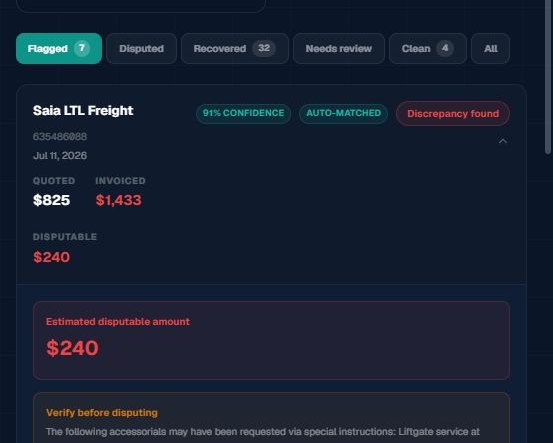
A system that recomputes every charge on every invoice generates a lot of comparisons, most of which will match exactly or within a trivial rounding difference. Useful detection applies a tolerance threshold so that immaterial differences pass through untouched, and only genuine discrepancies get surfaced with the specific line, the amount billed, and the amount that was actually owed attached. That specificity is what turns a flagged line into a usable finding instead of a pile of invoices someone still has to read one by one.
Why manual review misses what systematic detection catches
None of the checks above are impossible to do by hand. The constraint is volume and repetition, not difficulty. A person auditing invoices has to recompute a density calculation, pull the correct week's fuel index, and cross-reference a delivery receipt, for every invoice, every week, without the checks quietly narrowing to a sample once the backlog grows. In practice that narrowing happens fast: the fuel index changes weekly, the delivery receipt has to be tracked down separately from the invoice, and the person who booked the shipment has usually moved on by the time its invoice shows up. Systematic detection does not skip a week; it runs the same recomputation on every invoice, on the day it arrives, against the record already on file.
How LanePilot runs this detection automatically
LanePilot is the LTL TMS for small shippers: it connects to your carriers, quotes, and bookings, and holds the original quote, the declared weight and class, and the shipment record for every load as the system of record. When an invoice arrives, it runs the field-by-field checks above automatically, weight, class, accessorials, rate, and fuel surcharge, on every invoice rather than a sample, and flags anything that does not match with the documentation behind it.
LanePilot does not send, file, or negotiate a dispute with your carrier. Detection identifies the discrepancy and prepares the paperwork; you remain the party of record and submit the dispute letter yourself. See how LanePilot runs this detection on every invoice, or run a free audit on a recent shipment (send both the invoice and the original quote) to see what it finds.
Frequently Asked Questions
Can LTL billing errors be detected automatically?
Yes. Automated detection connects to a shipper's own quote, booking, and carrier data, holds the original terms for every shipment, then checks each invoice's weight, class, accessorials, and fuel surcharge against that record when the invoice arrives, flagging any charge that does not match. That differs from a manual audit, which usually checks a sample of invoices by hand.
What is the difference between a freight bill audit and automated billing-error detection?
A freight bill audit is the underlying check: comparing an invoice against the quote and shipment paperwork. Automated detection runs that same check on every invoice as it arrives instead of on a sample, and recomputes charges like the fuel surcharge and freight class instead of eyeballing whether they look right.
Why do manual freight audits miss errors that automated detection catches?
Manual review has to fit inside the hours available, so it samples instead of checking everything, and it tends to compare the invoice total rather than recomputing each line separately. A reweigh error and a fuel surcharge error can partially offset each other in the total, which hides both from a total-only review.
What records does billing-error detection need to work?
The original quote, the declared weight and class at booking, and the delivery receipt for each shipment, held against the invoice when it arrives. Without the quote specifically, there is no reference point to compare the invoice's rate and class against, so a mismatch cannot be told apart from a normal charge.